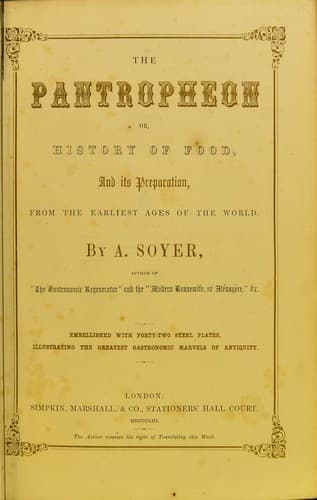
The Pantropheon; Or, History of Food, Its Preparation, from the Earliest Ages of the WorldSoyer, Alexis
History
The Pantropheon; Or, History of Food, Its Preparation, from the Earliest Ages of the World
Soyer, Alexis
Cooking; Food; Gastronomy
In China, the tea that forms the habitual beverage of the people is a
very inferior species of the _Boo_ tea.
The provinces of Kiang-Nang, Kiang-Si, and Che-Kiang, furnish green tea
to Russia, the United States, Calcutta, and various European countries;
the province of Fo-Kien furnishes black tea to England, with the
exception of a third of the _boo_ tea, or _bohee_, which is exported
from a district called Wo-Ping, lying to the north-west of the province
of Canton.
It is in Fo-Kien that the cultivation of this precious shrub is held in
the highest estimation. In this province it is deprived of a large
number of its buds at the beginning of the spring. Of these are made the
tea _Pé-ko_, the most renowned of all kinds. Congo tea serves to perfume
part of these buds, and to impart to them a more agreeable flavour.
A first gathering of full-grown leaves takes place at the commencement
of May, a second towards the middle of June, and a third and last at the
end of the summer. This produces a tea inferior to the preceding kinds
in point of quality and perfume.
The inhabitants of Fo-Kien cultivate tea in inclosures; and at the time
of harvest sell the leaves to a class of persons who undertake their
preparation, which consists in drying the leaves in houses, first by the
simple contact with the air, afterwards in heated warehouses. When the
preparation is terminated, the merchants come and make choice of the
best qualities; then the desiccation of the tea is finished, and it is
forwarded in packets, each bearing its proper designation.
As soon as the leaves have been gathered and selected, they are plunged
in boiling water, where they remain about thirty seconds; they are then
quickly withdrawn, strained, and thrown on iron plates, large and flat,
placed above a furnace: the workmen’s hands can hardly endure the heat
of these plates. They continually stir the leaves till they are
sufficiently heated, after which they take them off, and spread them on
large tables covered with mats. Other workmen then busy themselves with
rolling them with the palm of the hand, while others cool them as
quickly as possible by agitating the air with large fans. This operation
must be continued until the leaves have completely cooled under the hand
of the person who rolls them, for it is by being quickly cooled that the
leaves remain longer curled. Thanks to the operation of rolling them,
which is repeated two or three times, the leaves are deprived of their
humidity, and the unwholesome bitter juice they contain. For teas of the
first quality, each leaf must be rolled separately; but for more common
kinds, several may be rolled at once. Tea, thus prepared, is dried, and
put into boxes or cases free from moisture. The Chinese then aromatise
it with various odoriferous plants, such as the flowers of the _olea
fragrans_, and those of the _camellia sesangua_, shrubs of the same
family as tea; or those of the scented tea-roses and orange-flowers.
Public-domain text, read in full here on John Shaqi.
Reviews
Reviews
No reviews yet
Be the first to share your thoughts on this work.
Elsewhere in the archive
Join the Discussion
Join the discussion
Sign in to leave a comment or review.
Sign InorCreate an account