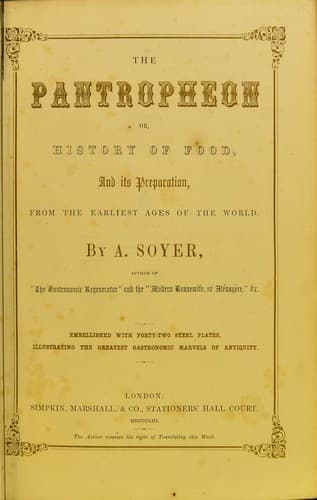
The Pantropheon; Or, History of Food, Its Preparation, from the Earliest Ages of the WorldSoyer, Alexis
History
The Pantropheon; Or, History of Food, Its Preparation, from the Earliest Ages of the World
Soyer, Alexis
Cooking; Food; Gastronomy
The _apomeli_ was nothing more than water in which honeycomb had been
boiled.[XXVI-40] _Omphacomeli_, an ingenious mixture of honey and
verjuice, quenched thirst during the summer, and produced that agreeable
gaiety which is to drunkenness what doziness is to sleep.[XXVI-41]
A mixture of honey and juice of myrtle seed, of course diluted with
water, composed _myrtites_, the aromatic flavour of which flattered the
palate, and rendered the breath more sweet.[XXVI-42] Sometimes
pomegranates were substituted for the myrtle, and it was then called
_rhoites_, and possessed an agreeable and pungent flavour.[XXVI-43]
Wine made of dates enjoyed a general esteem in the east. The Romans, who
knew also how to appreciate it, prepared it by throwing into water some
common, though very ripe, dates; and when they had well soaked, they
were put under a press.[XXVI-44] The same means were employed to procure
fig wine; but often the sediment of grapes was used instead of water, to
prevent its being too sweet.[XXVI-45]
“Artificial wines” were also procured by the aid of several other kinds
of fruits, such as sorbs, medlars, and mulberries.[XXVI-46] Fermentation
dispelled the sweet and insipid flavour which generally distinguishes
these fruits; and, at the commencement of a repast, the guests swallowed
with delight large cups of these beverages.[XXVI-47]
It was also the custom to serve very cold water, in which certain plants
had been infused, and which was freshened by being surrounded with snow
after it had been boiled for some time. The invention of this iced water
is attributed to the Emperor Nero, who made great use of it; and who
appears to have bitterly regretted it when, dethroned and flying from
his assassins, he was constrained through excessive thirst to drink
muddy water from a ditch. The unfortunate Cæsar then, for the first
time, thought of the strange vicissitudes of fortune, and casting a
sorrowful glance at the disgusting fluid he held in his hand, “Alas!” he
exclaimed, with a sigh, “is this the iced water that Nero
drank?”[XXVI-48]
TEA.
This plant is a native of China, and it is only in the Celestial Empire
that tea is cultivated to any great extent. Why, then, is it neglected
on all other points of the globe situated in the same latitude?
Doubtless, because the soil of China is superior for its culture to that
of any other country.
The shrub that produces tea is cultivated between the twenty-third and
thirty-third degrees of latitude; it thrives on the mountainous parts,
on the slope of the hills, and that which grows on high ground is far
superior to that gathered in the valleys. It is the same with this plant
as with the vine in France and in Europe; it grows on flat land, and
succeeds wonderfully on plains exposed to the sun’s rays.
The Chinese export teas of the first quality in much greater proportion
than those of an inferior kind. In England there is a larger consumption
than in any other country in the world.
Public-domain text, read in full here on John Shaqi.
Reviews
Reviews
No reviews yet
Be the first to share your thoughts on this work.
Elsewhere in the archive
Join the Discussion
Join the discussion
Sign in to leave a comment or review.
Sign InorCreate an account