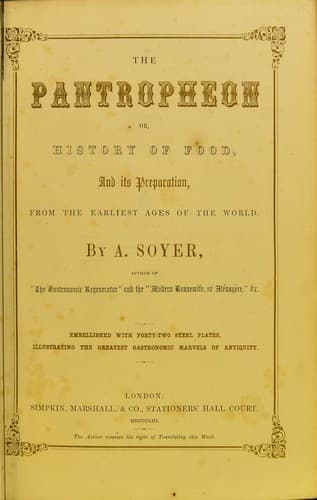
The Pantropheon; Or, History of Food, Its Preparation, from the Earliest Ages of the WorldSoyer, Alexis
History
The Pantropheon; Or, History of Food, Its Preparation, from the Earliest Ages of the World
Soyer, Alexis
Cooking; Food; Gastronomy
In Belgium, in the province of Liege, coffee is mixed with wild chicory
root. This method, generally known, is at the present time practised
throughout the whole of Europe; and wild chicory root then opened for
Liege a new branch of commerce. Lastly, in Flanders some of the
inhabitants cultivate the lupin, which they complacently call coffee,
and whose seed, roasted, they drink instead of real coffee.
“The infusion of coffee is thought to be beneficial to stout and
phlegmatic persons, and for pains in the head; but it appears that its
admixture with cream or milk prevents these good effects, on account of
the relaxation it thus causes to the stomach. On the contrary, it gives
strength when taken pure. It is doubtless for this reason that the
inhabitants of the colonies take it three and four times a day--that is,
at four o’clock in the morning, a very strong infusion, sometimes
without sugar; at breakfast, with milk; after dinner, pure; and often in
the afternoon, for the fourth time.”--BEAUVAIS.
We are unacquainted with the period of the introduction of coffee into
Europe. Rauwolf is the first who speaks of coffee, in 1588. Prospero
Alpini then came, and described the coffee tree in Egypt by the name of
_bon_, _bun_, or _boun_: his work appeared in 1591. In 1614, Bacon
mentioned this oriental beverage, and Meissner published a treatise on
it in 1621.
It was not, however, until towards the year 1645, that it began to be
drunk in Italy. The first _cafés_ were opened in London in 1652, and in
Paris in 1669, a time at which a pound of coffee was worth forty crowns.
It was principally Soliman Aga, the ambassador from Turkey, who caused
coffee to become fashionable in Paris.
It penetrated into Sweden in the year 1674, where it was thought of use
in scorbutic diseases. The first person who made trial of coffee with
milk was Nieuhoff, the Dutch ambassador in China, in imitation of tea
with milk.
“The physical effects of coffee are well known: it accelerates the
circulation of the blood, but sometimes causes palpitation of the heart
and giddiness; it has even been thought to occasion apoplexy and
paralysis. Nevertheless, celebrated writers--such as Fontenelle and
Voltaire--made constant use of it, almost to an abuse. They were told,
_it is a slow poison_; it was indeed slow for these learned men, who
died, the one at a hundred, the other eighty-four years of age. However,
at the present time coffee is a beverage whose power over our
intellectual or moral habits has, perhaps, never been calculated as it
deserves, since it has become general, and almost suppressed the
drunkenness which disgraced our ancestors at the end of their grand
repasts.”--VIREY.
Public-domain text, read in full here on John Shaqi.
Reviews
Reviews
No reviews yet
Be the first to share your thoughts on this work.
Elsewhere in the archive
Join the Discussion
Join the discussion
Sign in to leave a comment or review.
Sign InorCreate an account