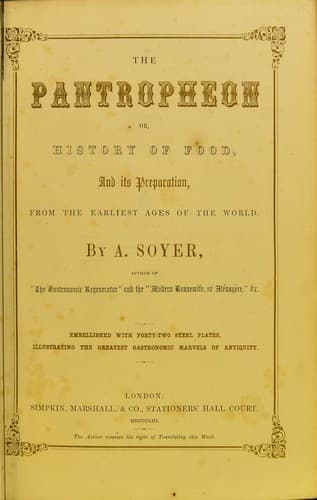
The Pantropheon; Or, History of Food, Its Preparation, from the Earliest Ages of the WorldSoyer, Alexis
History
The Pantropheon; Or, History of Food, Its Preparation, from the Earliest Ages of the World
Soyer, Alexis
Cooking; Food; Gastronomy
The cups of the Homeric times were all of equal capacity; one of them
was offered to each guest, but several were offered to persons of high
distinction.[XXVII-13]
The Greeks thought much of their cups; for them they were sacred relics
from father to son, and were only used on certain solemnities. Thus
Œdipus delivers the most frightful imprecation against his son
Polynices, who had presented, at a common repast, the cup of his
ancestors.[XXVII-14] That of Nestor was so large that a young man could
hardly carry it; as to him, he lifted it up without the slightest
difficulty.[XXVII-15]
The Athenians drank from cups in the shape of horns.[XXVII-16] Wax vases
were sufficient for the Spaniards.[XXVII-17] The Gaul who had thrown
down an Urus (wild ox) took its horns, decorated them with silver and
gold rings, and made his guests drink out of them.[XXVII-18] Often the
skull of an enemy, killed in single combat, was transformed into a cup
of honour, and reminded a Gallic family of the memorable action of a
valiant ancestor.[XXVII-19]
The first cups of the Romans were made of horns, or of the earthenware
of Samos.[XXVII-20] Those conquerors of the world had not yet enervated
their manly courage with the luxurious spoils of conquered nations.
Afterwards, some very simple ones were made of beech-wood[XXVII-21] or
elder;[XXVII-22] these possessed a marvellous property which they ought
to have always preserved--the wine only escaped from them, and they
retained the water which had been mixed with it.[XXVII-23]
But Rome, already tired of its austere simplicity, and its disdain for
the Greek cups of glass and crystal, soon began to desire something
finer. Those magnificent chalices, master-pieces of patience and skill,
in which gold and silver were amalgamated with a more brittle
material,[XXVII-24] were soon in much request, and appeared worthy of
their renown.
But it is to be observed, that the crystal of which the most precious
cups were made, had not the slightest similarity to that which we make
use of now, and which the least shock will break; it was flexible and
malleable;[XXVII-25] it might be thrown on the pavement with impunity,
and remained unhurt.[XXVII-26]
Here is, on this subject, a curious anecdote, which has been left to us
by Petronius:--
A certain skilful workman used to make crystal vases as strong as vases
of gold and silver. He produced an incomparable masterpiece; it was a
chalice of astonishing beauty, which he thought worthy of Cæsar only,
and which he felt a pride in offering to him. Tiberius highly praised
the skill and the rich present of the artist. This man, wishing to
increase still more the admiration of the prince, and secure his favours
to a greater degree, begged of him to give back the vase. He then threw
it with all his might on the marble pavement of the
DESCRIPTION OF PLATE No. XIX.
Public-domain text, read in full here on John Shaqi.
Reviews
Reviews
No reviews yet
Be the first to share your thoughts on this work.
Elsewhere in the archive
Join the Discussion
Join the discussion
Sign in to leave a comment or review.
Sign InorCreate an account