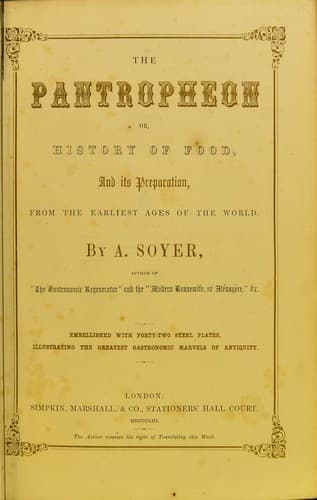
The Pantropheon; Or, History of Food, Its Preparation, from the Earliest Ages of the WorldSoyer, Alexis
History
The Pantropheon; Or, History of Food, Its Preparation, from the Earliest Ages of the World
Soyer, Alexis
Cooking; Food; Gastronomy
Nos. 1. and 2. Drinking horns; these give us an idea how the
ancient Greeks and Romans made use of the horns: taken from two
paintings at Herculaneum.
No. 3. A horn, with a chimerical head, in Grecian terra
cotta.--“_Herculan. Bronsi_,” II., 2, 3.
[Illustration: _Pl. 19._]
[Illustration: _Pl. 20_]
apartment: the hardest metal could never have resisted this terrible
shock. Cæsar appeared moved, and was silent. The artist, with a
triumphant smile, picked up the vase, which had only a slight dent, and
which, by striking it with the hammer, was soon brought to its original
state. This being done, no doubt remained on his mind that he had
conquered the good graces of the Emperor, and the esteem of an
astonished court. Tiberius asked him if he was the only one who knew how
to work crystal in so remarkable a manner? The workman immediately
answered that no one possessed his secret. “Very well,” said Cæsar, “let
his head be struck off without loss of time; for if this strange
invention were known, gold and silver would very soon have not the least
value.”[XXVII-27] Thus did the Emperor Tiberius encourage artists and
the arts.
There were, besides, cups made of the most pure crystal, “the
brittleness of which seems to have added to their price,”[XXVII-28] and
which were paid for dearer than gold and precious stones;[XXVII-29] but
much less, however, than those famous Murrhine vases, which have so long
exercised the useless sagacity of ancient commentators.
Among the rich spoils that Pompey, conqueror of Mithridates and master
of a part of Asia, ostentatiously displayed in his triumph,[XXVII-30]
the Romans, for the first time, admired vases and cups, the material and
workmanship of which surpassed all that the imagination could fancy the
most graceful and delicate.[XXVII-31] They were much in request; the
price was exorbitant, and thenceforth they were indispensable. One of
the ancient consuls thought himself too happy to give only a little more
than £6,000 for one of those Murrhines. Such was the name given to this
brittle and rare novelty. Petronius paid for a large basin £28,800;
DESCRIPTION OF PLATE No. XX.
Public-domain text, read in full here on John Shaqi.
Reviews
Reviews
No reviews yet
Be the first to share your thoughts on this work.
Elsewhere in the archive
Join the Discussion
Join the discussion
Sign in to leave a comment or review.
Sign InorCreate an account