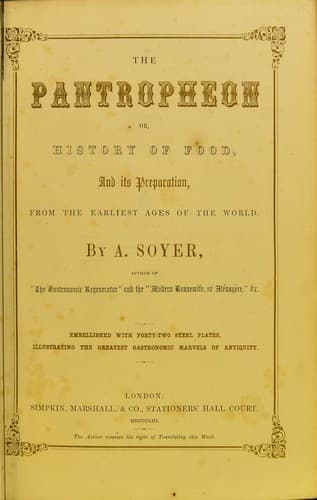
The Pantropheon; Or, History of Food, Its Preparation, from the Earliest Ages of the WorldSoyer, Alexis
History
The Pantropheon; Or, History of Food, Its Preparation, from the Earliest Ages of the World
Soyer, Alexis
Cooking; Food; Gastronomy
The growths of Lebanon,[XXVIII-11] of Helbon,[XXVIII-12] and of
Sorec,[XXVIII-13] enjoyed an extraordinary reputation, and the delicious
wine they produced was capable of inspiring the lyric David with that
celebrated praise[XXVIII-14] by which intemperance has often dared to
authorize reprehensible excesses.
However, the Hebrews, a sober people, like all eastern nations, rarely
made use of pure wine; they generally mixed it with a quantity of water,
and only drank a little at some ceremonial feasts, and at the end of
their repasts.[XXVIII-15] They sometimes mixed with it perfumes and
odoriferous drugs.[XXVIII-16]
Some nations seem to have had a great horror of wine. The Persians drank
nothing but water;[XXVIII-17] and the inhabitants of Pontus, the
Scythians, and the Cappadocians, partook of this strange
taste.[XXVIII-18] The Arcadians, who lived on chesnuts and acorns, were
not worthy of the favours of Bacchus; neither were the troglodytes, the
ichthyophagists, and other swarms of hydropotes who were as yet too
little civilized to ask of drunkenness its illusions and its
enchantments.[XXVIII-19]
The Egyptians would have thought it a profanation of their temples to
carry in a flagon of the rosy liquid; but Psammetichus came (670 B.C.),
and that wise prince made them understand that a pot of beer is not
worth a cup of good wine.[XXVIII-20]
The Romans asserted that their old king, Janus, planted the first vine
in Italy,[XXVIII-21] and that, later, Numa taught them how to trim
it.[XXVIII-22] That noble people knew how to appreciate such blessings,
and in order to demonstrate that wisdom is always to be found in wine,
they never failed to place on their altars the statue of Minerva beside
that of Bacchus.[XXVIII-23]
The inflexible muse of history has preserved to us the name of the
individual who doomed himself to a sorry sort of immortality by
inventing the custom of mixing water with wine; it was Cranaüs, King of
Athens, 1532 B.C.[XXVIII-24] The gods, doubtless to punish him, caused a
great part of Greece to be inundated, and it was not long before he was
dethroned.[XXVIII-25] Pliny accuses the obscure Staphil, sou of
Sithen,[XXVIII-26] of this depravation of taste, which gained upon
imitators to such an extent that, in the time of Diodorus of Sicily (45
B.C.), the guests still mixed water with their wine at the end of the
repast.[XXVIII-27] It is true that they were then all intoxicated.
Public-domain text, read in full here on John Shaqi.
Reviews
Reviews
No reviews yet
Be the first to share your thoughts on this work.
Elsewhere in the archive
Join the Discussion
Join the discussion
Sign in to leave a comment or review.
Sign InorCreate an account