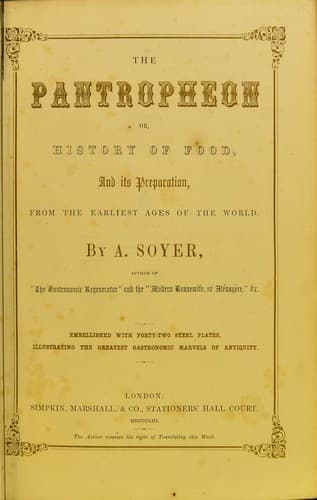
The Pantropheon; Or, History of Food, Its Preparation, from the Earliest Ages of the WorldSoyer, Alexis
History
The Pantropheon; Or, History of Food, Its Preparation, from the Earliest Ages of the World
Soyer, Alexis
Cooking; Food; Gastronomy
MURRHINE VASE.--This vase is the most precious of all those which
have come down to us. It is drawn here half the original size, and
belongs to Prince de Biscari, in Sicily, which has been described
by him in the dissertation entitled, “_De Vasi Murrini
Ragionamenti_.” Three pieces of opal in the first place form the
cup; the second, the stem; and the last, the base of the foot. If
this vase is an antique, as it is said by the Prince de Biscari; if
true that several pieces of opal have often been found as large and
as fine (which appears doubtful, in the actual state of mineralogic
knowledge), the question upon the Murrhine vases would be decided.
They would have been of opal, and not porcelain; neither of
sardonyx--_Pierre de lard_--as many have believed, nor of
_cacholong_ (a species of chalcedony, opaque, and of a yellowish
white), as I have described it.
XXVIII.
WINE.
Bacchus, son of Ammon, was born in Egypt, and was the first who taught
his countrymen the art of cultivating the vine, and of making wine. He
is the same as Osiris, the famous conqueror of India.[XXVIII-1] Should
this assertion be contradicted, we shall only entreat any and every
disputant to make his own choice of the god of vineyards, from among the
five heroes bearing the name of Bacchus, as we are too impartial to
prefer any one in particular.[XXVIII-2]
Œnopion, worthy son of one of these heroes, enriched the inhabitants
of Chios with the first rosy wine that ever yet obscured their
reason.[XXVIII-3] Greece, Italy, and Sicily owed this wonderful liquor
to the Egyptians. The Gauls received this sweet present from a Tuscan,
who had been banished from Clusium, his country;[XXVIII-4] and the
cultivation of the grape spread rapidly till the reign of the sanguinary
Domitian, who completed the catalogue of his crimes by tearing up the
vines.[XXVIII-5] The Emperor Probus restored them to the disconsolate
Gauls.[XXVIII-6] That prince was certainly worthy of his name!
Modern science, agreeing with holy writ,[XXVIII-7] looks upon the east
as the common cradle of the vine and the human race.
Palestine was renowned for its vines. Pliny speaks in praise of
them.[XXVIII-8] The vineyards constituted a part of the riches of the
country, and they were preserved with the greatest care; so much so that
Moses, with an especial view to vines, forbade the sowing of different
seeds in the same field, on pain of confiscation:[XXVIII-9] and it was
done to encourage their cultivation, that that wise legislator exempted
every person who had planted one from military service, and from all
public duties, until the first vintage.[XXVIII-10]
Public-domain text, read in full here on John Shaqi.
Reviews
Reviews
No reviews yet
Be the first to share your thoughts on this work.
Elsewhere in the archive
Join the Discussion
Join the discussion
Sign in to leave a comment or review.
Sign InorCreate an account