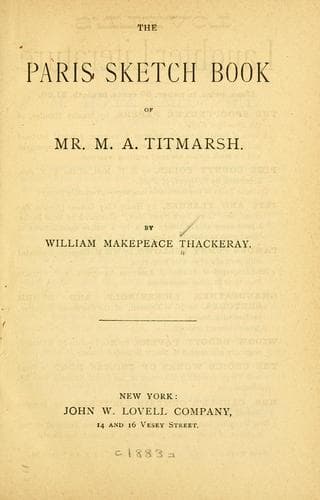
The Paris Sketch Book of Mr. M. A. TitmarshThackeray, William Makepeace
General
The Paris Sketch Book of Mr. M. A. Titmarsh
Thackeray, William Makepeace
Paris (France) -- Description and travel
To execute the legacy of the revolution, then; to fulfil his
providential mission; to keep his place,—in other words, for the
simplest are always the best,—to keep his place, and to keep his
Government in decent order, the Emperor was obliged to establish a
military despotism, to re-establish honors and titles; it was
necessary, as the Prince confesses, to restore the old prestige of the
Government, in order to make the people respect it; and he adds—a truth
which one hardly would expect from him,—“At the commencement of a new
society, it is the legislator who makes and corrects the manners;
later, it is the manners which preserve the laws.” Of course, and here
is the great risk that all revolutionizing people run—they must tend to
despotism; “they must personify themselves in a man,” is the Prince’s
phrase; and, according as is his temperament or disposition—according
as he is a Cromwell, a Washington, or a Napoleon—the revolution becomes
tyranny or freedom, prospers or falls.
Somewhere in the St. Helena memorials, Napoleon reports a message of
his to the Pope. “Tell the Pope,” he says to an archbishop, “to
remember that I have six hundred thousand armed Frenchmen, qui
marcheront avec moi, pour moi, et comme moi.” And this is the legacy of
the revolution, the advancement of freedom! A hundred volumes of
imperial special pleading will not avail against such a speech as
this—one so insolent, and at the same time so humiliating, which gives
unwittingly the whole of the Emperor’s progress, strength, and
weakness. The six hundred thousand armed Frenchmen were used up, and
the whole fabric falls; the six hundred thousand are reduced to sixty
thousand, and straightway all the rest of the fine imperial scheme
vanishes: the miserable senate, so crawling and abject but now, becomes
of a sudden endowed with a wondrous independence; the miserable sham
nobles, sham empress, sham kings, dukes, princes, chamberlains, pack up
their plumes and embroideries, pounce upon what money and plate they
can lay their hands on, and when the allies appear before Paris, when
for courage and manliness there is yet hope, when with fierce marches
hastening to the relief of his capital, bursting through ranks upon
ranks of the enemy, and crushing or scattering them from the path of
his swift and victorious despair, the Emperor at last is at home,—where
are the great dignitaries and the lieutenant-generals of the empire?
Where is Maria Louisa, the Empress Eagle, with her little callow king
of Rome? Is she going to defend her nest and her eaglet? Not she.
Empress-queen, lieutenant-general, and court dignitaries, are off on
the wings of all the winds—profligati sunt, they are away with the
money-bags, and Louis Stanislas Xavier rolls into the palace of his
fathers.
Public-domain text, read in full here on John Shaqi.
Reviews
Reviews
No reviews yet
Be the first to share your thoughts on this work.
Elsewhere in the archive
Join the Discussion
Join the discussion
Sign in to leave a comment or review.
Sign InorCreate an account