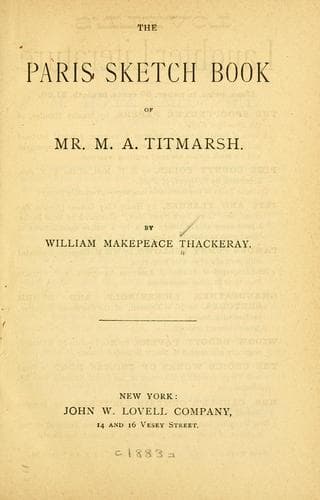
The Paris Sketch Book of Mr. M. A. TitmarshThackeray, William Makepeace
General
The Paris Sketch Book of Mr. M. A. Titmarsh
Thackeray, William Makepeace
Paris (France) -- Description and travel
With regard to Napoleon’s excellences as an administrator, a
legislator, a constructor of public works, and a skilful financier, his
nephew speaks with much diffuse praise, and few persons, we suppose,
will be disposed to contradict him. Whether the Emperor composed his
famous code, or borrowed it, is of little importance; but he
established it, and made the law equal for every man in France except
one. His vast public works and vaster wars were carried on without new
loans or exorbitant taxes; it was only the blood and liberty of the
people that were taxed, and we shall want a better advocate than Prince
Louis to show us that these were not most unnecessarily and lavishly
thrown away. As for the former and material improvements, it is not
necessary to confess here that a despotic energy can effect such far
more readily than a Government of which the strength is diffused in
many conflicting parties. No doubt, if we could create a despotical
governing machine, a steam autocrat,—passionless, untiring, and
supreme,—we should advance further, and live more at ease than under
any other form of government. Ministers might enjoy their pensions and
follow their own devices; Lord John might compose histories or
tragedies at his leisure, and Lord Palmerston, instead of racking his
brains to write leading articles for Cupid, might crown his locks with
flowers, and sing [Greek text omitted], his natural Anacreontics; but
alas! not so: if the despotic Government has its good side, Prince
Louis Napoleon must acknowledge that it has its bad, and it is for this
that the civilized world is compelled to substitute for it something
more orderly and less capricious. Good as the Imperial Government might
have been, it must be recollected, too, that since its first fall, both
the Emperor and his admirer and would-be successor have had their
chance of re-establishing it. “Fly from steeple to steeple” the eagles
of the former did actually, and according to promise perch for a while
on the towers of Notre Dame. We know the event: if the fate of war
declared against the Emperor, the country declared against him too;
and, with old Lafayette for a mouthpiece, the representatives of the
nation did, in a neat speech, pronounce themselves in permanence, but
spoke no more of the Emperor than if he had never been. Thereupon the
Emperor proclaimed his son the Emperor Napoleon II. “L’Empereur est
mort, vive l’Empereur!” shouted Prince Lucien. Psha! not a soul echoed
the words: the play was played, and as for old Lafayette and his
“permanent” representatives, a corporal with a hammer nailed up the
door of their spouting-club, and once more Louis Stanislas Xavier
rolled back to the bosom of his people.
Public-domain text, read in full here on John Shaqi.
Reviews
Reviews
No reviews yet
Be the first to share your thoughts on this work.
Elsewhere in the archive
Join the Discussion
Join the discussion
Sign in to leave a comment or review.
Sign InorCreate an account