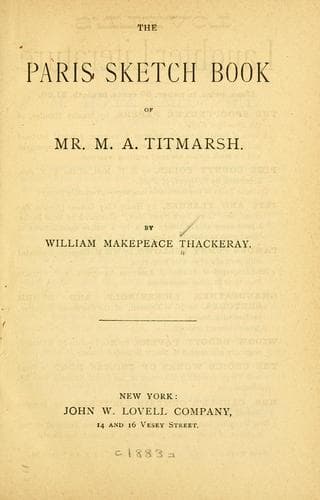
The Paris Sketch Book of Mr. M. A. TitmarshThackeray, William Makepeace
General
The Paris Sketch Book of Mr. M. A. Titmarsh
Thackeray, William Makepeace
Paris (France) -- Description and travel
* We have given a description of a genteel Macaire in the account of M.
de Bernard’s novels.
Will this satire apply anywhere in England? Have we any Consolidated
European Blacking Associations amongst us? Have we penniless directors
issuing El Dorado prospectuses, and jockeying their shares through the
market? For information on this head, we must refer the reader to the
newspapers; or if he be connected with the city, and acquainted with
commercial men, he will be able to say whether ALL the persons whose
names figure at the head of announcements of projected companies are as
rich as Rothschild, or quite as honest as heart could desire.
When Macaire has sufficiently exploité the Bourse, whether as a gambler
in the public funds or other companies, he sagely perceives that it is
time to turn to some other profession, and, providing himself with a
black gown, proposes blandly to Bertrand to set up—a new religion. “Mon
ami,” says the repentant sinner, “le temps de la commandite va passer,
MAIS LES BADAUDS NE PASSERONT PAS.” (O rare sentence! it should be
written in letters of gold!) “OCCUPONS NOUS DE CE QUI EST ÉTERNEL. Si
nous fassions une réligion?” On which M. Bertrand remarks, “A religion!
what the devil—a religion is not an easy thing to make.” But Macaire’s
receipt is easy. “Get a gown, take a shop,” he says, “borrow some
chairs, preach about Napoleon, or the discovery of America, or
Molière—and there’s a religion for you.”
We have quoted this sentence more for the contrast it offers with our
own manners, than for its merits. After the noble paragraph, “Les
badauds ne passeront pas. Occupons nous de ce qui est éternel,” one
would have expected better satire upon cant than the words that follow.
We are not in a condition to say whether the subjects chosen are those
that had been selected by Père Enfantin, or Chatel, or Lacordaire; but
the words are curious, we think, for the very reason that the satire is
so poor. The fact is, there is no religion in Paris; even clever M.
Philipon, who satirizes everything, and must know, therefore, some
little about the subject which he ridicules, has nothing to say but,
“Preach a sermon, and that makes a religion; anything will do.” If
ANYTHING will do, it is clear that the religious commodity is not in
much demand. Tartuffe had better things to say about hypocrisy in his
time; but then Faith was alive; now, there is no satirizing religious
cant in France, for its contrary, true religion, has disappeared
altogether; and having no substance, can cast no shadow. If a satirist
would lash the religious hypocrites in ENGLAND now—the High Church
hypocrites, the Low Church hypocrites, the promiscuous Dissenting
hypocrites, the No Popery hypocrites—he would have ample subject
enough. In France, the religious hypocrites went out with the Bourbons.
Those who remain pious in that country (or, rather, we should say, in
the capital, for of that we speak,) are unaffectedly so, for they have
Public-domain text, read in full here on John Shaqi.
Reviews
Reviews
No reviews yet
Be the first to share your thoughts on this work.
Elsewhere in the archive
Join the Discussion
Join the discussion
Sign in to leave a comment or review.
Sign InorCreate an account