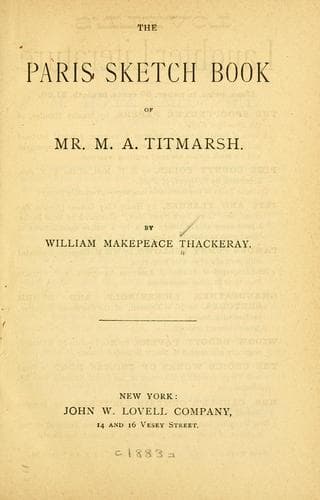
The Paris Sketch Book of Mr. M. A. TitmarshThackeray, William Makepeace
General
The Paris Sketch Book of Mr. M. A. Titmarsh
Thackeray, William Makepeace
Paris (France) -- Description and travel
no worldly benefit to hope for from their piety; the great majority
have no religion at all, and do not scoff at the few, for scoffing is
the minority’s weapon, and is passed always to the weaker side,
whatever that may be. Thus H. B. caricatures the Ministers: if by any
accident that body of men should be dismissed from their situations,
and be succeeded by H. B.’s friends, the Tories,—what must the poor
artist do? He must pine away and die, if he be not converted; he cannot
always be paying compliments; for caricature has a spice of Goethe’s
Devil in it, and is “der Geist der stets verneint,” the Spirit that is
always denying.
With one or two of the French writers and painters of caricatures, the
King tried the experiment of bribery; which succeeded occasionally in
buying off the enemy, and bringing him from the republican to the royal
camp; but when there, the deserter was never of any use. Figaro, when
so treated, grew fat and desponding, and lost all his sprightly VERVE;
and Nemesis became as gentle as a Quakeress. But these instances of
“ratting” were not many. Some few poets were bought over; but, among
men following the profession of the press, a change of politics is an
infringement of the point of honor, and a man must FIGHT as well as
apostatize. A very curious table might be made, signalizing the
difference of the moral standard between us and the French. Why is the
grossness and indelicacy, publicly permitted in England, unknown in
France, where private morality is certainly at a lower ebb? Why is the
point of private honor now more rigidly maintained among the French?
Why is it, as it should be, a moral disgrace for a Frenchman to go into
debt, and no disgrace for him to cheat his customer? Why is there more
honesty and less—more propriety and less?—and how are we to account for
the particular vices or virtues which belong to each nation in its
turn?
The above is the Reverend M. Macaire’s solitary exploit as a spiritual
swindler: as MAÎTRE Macaire in the courts of law, as avocat, avoué—in a
humbler capacity even, as a prisoner at the bar, he distinguishes
himself greatly, as may be imagined. On one occasion we find the
learned gentleman humanely visiting an unfortunate détenu—no other
person, in fact, than his friend M. Bertrand, who has fallen into some
trouble, and is awaiting the sentence of the law. He begins—
“Mon cher Bertrand, donne moi cent écus, je te fais acquitter
d’emblée.”
“J’ai pas d’argent.”
“Hé bien, donne moi cent francs.”
“Pas le sou.”
“Tu n’as pas dix francs?”
“Pas un liard.”
“Alors donne moi tes bottes, je plaiderai la circonstance atténuante.”
Public-domain text, read in full here on John Shaqi.
Reviews
Reviews
No reviews yet
Be the first to share your thoughts on this work.
Elsewhere in the archive
Join the Discussion
Join the discussion
Sign in to leave a comment or review.
Sign InorCreate an account