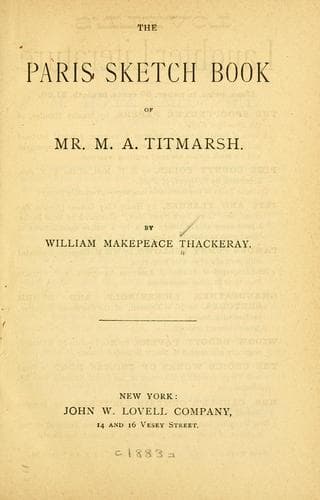
The Paris Sketch Book of Mr. M. A. TitmarshThackeray, William Makepeace
General
The Paris Sketch Book of Mr. M. A. Titmarsh
Thackeray, William Makepeace
Paris (France) -- Description and travel
The adventures of Doctor Macaire need not be described, because the
different degrees in quackery which are taken by that learned physician
are all well known in England, where we have the advantage of many
higher degrees in the science, which our neighbors know nothing about.
We have not Hahnemann, but we have his disciples; we have not
Broussais, but we have the College of Health; and surely a dose of
Morrison’s pills is a sublimer discovery than a draught of hot water.
We had St. John Long, too—where is his science?—and we are credibly
informed that some important cures have been effected by the inspired
dignitaries of “the church” in Newman Street which, if it continue to
practise, will sadly interfere with the profits of the regular
physicians, and where the miracles of the Abbé of Paris are about to be
acted over again.
In speaking of M. Macaire and his adventures, we have managed so
entirely to convince ourselves of the reality of the personage, that we
have quite forgotten to speak of Messrs. Philipon and Daumier, who are,
the one the inventor, the other the designer, of the Macaire Picture
Gallery. As works of esprit, these drawings are not more remarkable
than they are as works of art, and we never recollect to have seen a
series of sketches possessing more extraordinary cleverness and
variety. The countenance and figure of Macaire and the dear stupid
Bertrand are preserved, of course, with great fidelity throughout; but
the admirable way in which each fresh character is conceived, the
grotesque appropriateness of Robert’s every successive attitude and
gesticulation, and the variety of Bertrand’s postures of invariable
repose, the exquisite fitness of all the other characters, who act
their little part and disappear from the scene, cannot be described on
paper, or too highly lauded. The figures are very carelessly drawn;
but, if the reader can understand us, all the attitudes and limbs are
perfectly CONCEIVED, and wonderfully natural and various. After
pondering over these drawings for some hours, as we have been while
compiling this notice of them, we have grown to believe that the
personages are real, and the scenes remain imprinted on the brain as if
we had absolutely been present at their acting. Perhaps the clever way
in which the plates are colored, and the excellent effect which is put
into each, may add to this illusion. Now, in looking, for instance, at
H. B.’s slim vapory figures, they have struck us as excellent
LIKENESSES of men and women, but no more: the bodies want spirit,
action, and individuality. George Cruikshank, as a humorist, has quite
as much genius, but he does not know the art of “effect” so well as
Monsieur Daumier; and, if we might venture to give a word of advice to
another humorous designer, whose works are extensively circulated—the
illustrator of “Pickwick” and “Nicholas Nickleby,”—it would be to study
well these caricatures of Monsieur Daumier; who, though he executes
Public-domain text, read in full here on John Shaqi.
Reviews
Reviews
No reviews yet
Be the first to share your thoughts on this work.
Elsewhere in the archive
Join the Discussion
Join the discussion
Sign in to leave a comment or review.
Sign InorCreate an account