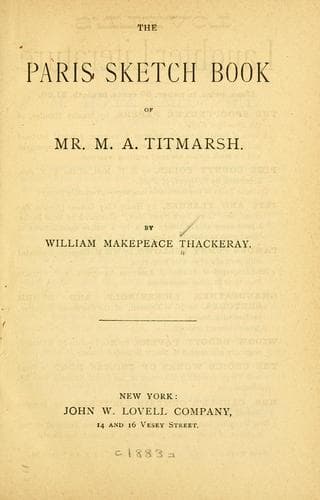
The Paris Sketch Book of Mr. M. A. TitmarshThackeray, William Makepeace
General
The Paris Sketch Book of Mr. M. A. Titmarsh
Thackeray, William Makepeace
Paris (France) -- Description and travel
very carelessly, knows very well what he would express, indicates
perfectly the attitude and identity of his figure, and is quite aware,
beforehand, of the effect which he intends to produce. The one we
should fancy to be a practised artist, taking his ease; the other, a
young one, somewhat bewildered: a very clever one, however, who, if he
would think more, and exaggerate less, would add not a little to his
reputation.
Having pursued, all through these remarks, the comparison between
English art and French art, English and French humor, manners, and
morals, perhaps we should endeavor, also, to write an analytical essay
on English cant or humbug, as distinguished from French. It might be
shown that the latter was more picturesque and startling, the former
more substantial and positive. It has none of the poetic flights of the
French genius, but advances steadily, and gains more ground in the end
than its sprightlier compeer. But such a discussion would carry us
through the whole range of French and English history, and the reader
has probably read quite enough of the subject in this and the foregoing
pages.
We shall, therefore, say no more of French and English caricatures
generally, or of Mr. Macaire’s particular accomplishments and
adventures. They are far better understood by examining the original
pictures, by which Philipon and Daumier have illustrated them, than by
translations first into print and afterwards into English. They form a
very curious and instructive commentary upon the present state of
society in Paris, and a hundred years hence, when the whole of this
struggling, noisy, busy, merry race shall have exchanged their
pleasures or occupations for a quiet coffin (and a tawdry lying
epitaph) at Montmartre, or Père la Chaise; when the follies here
recorded shall have been superseded by new ones, and the fools now so
active shall have given up the inheritance of the world to their
children: the latter will, at least, have the advantage of knowing,
intimately and exactly, the manners of life and being of their
grandsires, and calling up, when they so choose it, our ghosts from the
grave, to live, love, quarrel, swindle, suffer, and struggle on blindly
as of yore. And when the amused speculator shall have laughed
sufficiently at the immensity of our follies, and the paltriness of our
aims, smiled at our exploded superstitions, wondered how this man
should be considered great, who is now clean forgotten (as copious
Guthrie before mentioned); how this should have been thought a patriot
who is but a knave spouting commonplace; or how that should have been
dubbed a philosopher who is but a dull fool, blinking solemn, and
pretending to see in the dark; when he shall have examined all these at
his leisure, smiling in a pleasant contempt and good-humored
superiority, and thanking heaven for his increased lights, he will shut
the book, and be a fool as his fathers were before him.
Public-domain text, read in full here on John Shaqi.
Reviews
Reviews
No reviews yet
Be the first to share your thoughts on this work.
Elsewhere in the archive
Join the Discussion
Join the discussion
Sign in to leave a comment or review.
Sign InorCreate an account