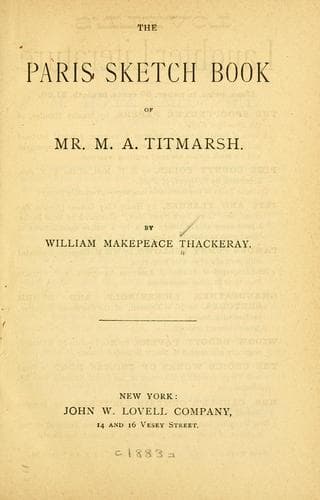
The Paris Sketch Book of Mr. M. A. TitmarshThackeray, William Makepeace
General
The Paris Sketch Book of Mr. M. A. Titmarsh
Thackeray, William Makepeace
Paris (France) -- Description and travel
“Come away,” said Mercurius; “he hath yet got wield, field, sealed,
congealed, and a dozen other rhymes beside; and after the song will
come the supper.”
So the poor soul was obliged to go; while the lady listened, and the
page sung away till morning.
“My virtues have been my ruin,” said poor Sir Rollo, as he and
Mercurius slunk silently out of the window. “Had I hanged that knave
Edward, as I did the page his predecessor, my niece would have sung
mine ave, and I should have been by this time an angel in heaven.”
“He is reserved for wiser purposes,” responded the devil: “he will
assassinate your successor, the lady Mathilde’s brother; and, in
consequence, will be hanged. In the love of the lady he will be
succeeded by a gardener, who will be replaced by a monk, who will give
way to an ostler, who will be deposed by a Jew pedler, who shall,
finally, yield to a noble earl, the future husband of the fair
Mathilde. So that, you see, instead of having one poor soul a-frying,
we may now look forward to a goodly harvest for our lord the Devil.”
The soul of the Baron began to think that his companion knew too much
for one who would make fair bets; but there was no help for it; he
would not, and he could not, cry off: and he prayed inwardly that the
brother might be found more pious than the sister.
But there seemed little chance of this. As they crossed the court,
lackeys, with smoking dishes and, full jugs, passed and repassed
continually, although it was long past midnight. On entering the hall,
they found Sir Randal at the head of a vast table, surrounded by a
fiercer and more motley collection of individuals than had congregated
there even in the time of Sir Rollo. The lord of the castle had
signified that “it was his royal pleasure to be drunk,” and the
gentlemen of his train had obsequiously followed their master.
Mercurius was delighted with the scene, and relaxed his usually rigid
countenance into a bland and benevolent smile, which became him
wonderfully.
The entrance of Sir Roger, who had been dead about a year, and a person
with hoofs, horns, and a tail, rather disturbed the hilarity of the
company. Sir Randal dropped his cup of wine; and Father Peter, the
confessor, incontinently paused in the midst of a profane song, with
which he was amusing the society.
“Holy Mother!” cried he, “it is Sir Roger.”
“Alive!” screamed Sir Randal.
“No, my lord,” Mercurius said; “Sir Roger is dead, but cometh on a
matter of business; and I have the honor to act as his counsellor and
attendant.”
“Nephew,” said Sir Roger, “the daemon saith justly; I am come on a
trifling affair, in which thy service is essential.”
“I will do anything, uncle, in my power.”
“Thou canst give me life, if thou wilt?” But Sir Randal looked very
blank at this proposition. “I mean life spiritual, Randal,” said Sir
Roger; and thereupon he explained to him the nature of the wager.
Public-domain text, read in full here on John Shaqi.
Reviews
Reviews
No reviews yet
Be the first to share your thoughts on this work.
Elsewhere in the archive
Join the Discussion
Join the discussion
Sign in to leave a comment or review.
Sign InorCreate an account