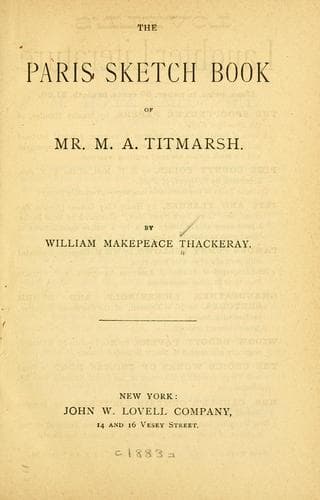
The Paris Sketch Book of Mr. M. A. TitmarshThackeray, William Makepeace
General
The Paris Sketch Book of Mr. M. A. Titmarsh
Thackeray, William Makepeace
Paris (France) -- Description and travel
Whilst he was telling his story, his companion Mercurius was playing
all sorts of antics in the hall; and, by his wit and fun, became so
popular with this godless crew, that they lost all the fear which his
first appearance had given them. The friar was wonderfully taken with
him, and used his utmost eloquence and endeavors to convert the devil;
the knights stopped drinking to listen to the argument; the men-at-arms
forbore brawling; and the wicked little pages crowded round the two
strange disputants, to hear their edifying discourse. The ghostly man,
however, had little chance in the controversy, and certainly little
learning to carry it on. Sir Randal interrupted him. “Father Peter,”
said he, “our kinsman is condemned for ever, for want of a single ave:
wilt thou say it for him?” “Willingly, my lord,” said the monk, “with
my book;” and accordingly he produced his missal to read, without which
aid it appeared that the holy father could not manage the desired
prayer. But the crafty Mercurius had, by his devilish art, inserted a
song in the place of the ave, so that Father Peter, instead of chanting
an hymn, sang the following irreverent ditty—
“Some love the matin-chimes, which toll
The hour of prayer to sinner:
But better far’s the mid-day bell,
Which speaks the hour of dinner;
For when I see a smoking fish,
Or capon drown’d in gravy,
Or noble haunch on silver dish,
Full glad I sing mine ave.
“My pulpit is an ale-house bench,
Whereon I sit so jolly;
A smiling rosy country wench
My saint and patron holy.
I kiss her cheek so red and sleek,
I press her ringlets wavy;
And in her willing ear I speak
A most religious ave.
“And if I’m blind, yet heaven is kind,
And holy saints forgiving;
For sure he leads a right good life
Who thus admires good living.
Above, they say, our flesh is air,
Our blood celestial ichor:
Oh, grant! mid all the changes there,
They may not change our liquor!”
And with this pious wish the holy confessor tumbled under the table in
an agony of devout drunkenness; whilst the knights, the men-at-arms,
and the wicked little pages, rang out the last verse with a most
melodious and emphatic glee. “I am sorry, fair uncle,” hiccupped Sir
Randal, “that, in the matter of the ave, we could not oblige thee in a
more orthodox manner; but the holy father has failed, and there is not
another man in the hall who hath an idea of a prayer.”
“It is my own fault,” said Sir Rollo; “for I hanged the last
confessor.” And he wished his nephew a surly good-night, as he prepared
to quit the room.
“Au revoir, gentlemen,” said the devil Mercurius; and once more fixed
his tail round the neck of his disappointed companion.
Public-domain text, read in full here on John Shaqi.
Reviews
Reviews
No reviews yet
Be the first to share your thoughts on this work.
Elsewhere in the archive
Join the Discussion
Join the discussion
Sign in to leave a comment or review.
Sign InorCreate an account