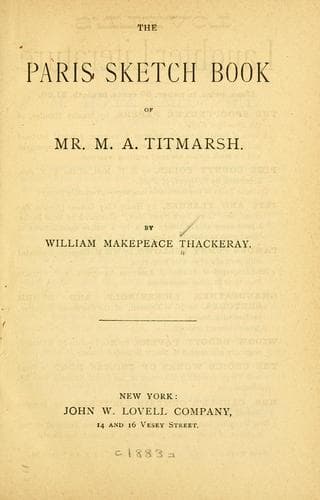
The Paris Sketch Book of Mr. M. A. TitmarshThackeray, William Makepeace
General
The Paris Sketch Book of Mr. M. A. Titmarsh
Thackeray, William Makepeace
Paris (France) -- Description and travel
However, if the immortal Görres and the German mystics have had their
day, there is the immortal Göthe, and the Pantheists; and I incline to
think that the fashion has set very strongly in their favor. Voltaire
and the Encyclopaedians are voted, now, barbares, and there is no term
of reprobation strong enough for heartless Humes and Helvetiuses, who
lived but to destroy, and who only thought to doubt. Wretched as
Voltaire’s sneers and puns are, I think there is something more manly
and earnest even in them, than in the present muddy French
transcendentalism. Pantheism is the word now; one and all have begun to
éprouver the besoin of a religious sentiment; and we are deluged with a
host of gods accordingly. Monsieur de Balzac feels himself to be
inspired; Victor Hugo is a god; Madame Sand is a god; that tawdry man
of genius, Jules Janin, who writes theatrical reviews for the Débats,
has divine intimations; and there is scarce a beggarly, beardless
scribbler of poems and prose, but tells you, in his preface, of the
sainteté of the sacerdoce littéraire; or a dirty student, sucking
tobacco and beer, and reeling home with a grisette from the chaumière,
who is not convinced of the necessity of a new “Messianism,” and will
hiccup, to such as will listen, chapters of his own drunken Apocalypse.
Surely, the negatives of the old days were far less dangerous than the
assertions of the present; and you may fancy what a religion that must
be, which has such high priests.
There is no reason to trouble the reader with details of the lives of
many of these prophets and expounders of new revelations. Madame Sand,
for instance, I do not know personally, and can only speak of her from
report. True or false, the history, at any rate, is not very edifying;
and so may be passed over: but, as a certain great philosopher told us,
in very humble and simple words, that we are not to expect to gather
grapes from thorns, or figs from thistles, we may, at least, demand, in
all persons assuming the character of moralist or philosopher—order,
soberness, and regularity of life; for we are apt to distrust the
intellect that we fancy can be swayed by circumstance or passion; and
we know how circumstance and passion WILL sway the intellect: how
mortified vanity will form excuses for itself; and how temper turns
angrily upon conscience, that reproves it. How often have we called our
judge our enemy, because he has given sentence against us!—How often
have we called the right wrong, because the right condemns us! And in
the lives of many of the bitter foes of the Christian doctrine, can we
find no personal reason for their hostility? The men in Athens said it
was out of regard for religion that they murdered Socrates; but we have
had time, since then, to reconsider the verdict; and Socrates’
character is pretty pure now, in spite of the sentence and the jury of
those days.
Public-domain text, read in full here on John Shaqi.
Reviews
Reviews
No reviews yet
Be the first to share your thoughts on this work.
Elsewhere in the archive
Join the Discussion
Join the discussion
Sign in to leave a comment or review.
Sign InorCreate an account