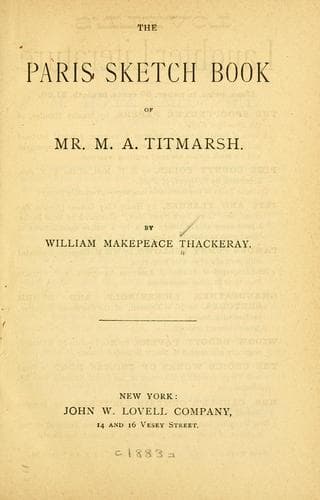
The Paris Sketch Book of Mr. M. A. TitmarshThackeray, William Makepeace
General
The Paris Sketch Book of Mr. M. A. Titmarsh
Thackeray, William Makepeace
Paris (France) -- Description and travel
The Parisian philosophers will attempt to explain to you the changes
through which Madame Sand’s mind has passed,—the initiatory trials,
labors, and sufferings which she has had to go through,—before she
reached her present happy state of mental illumination. She teaches her
wisdom in parables, that are, mostly, a couple of volumes long; and
began, first, by an eloquent attack on marriage, in the charming novel
of “Indiana.” “Pity,” cried she, “for the poor woman who, united to a
being whose brute force makes him her superior, should venture to break
the bondage which is imposed on her, and allow her heart to be free.”
In support of this claim of pity, she writes two volumes of the most
exquisite prose. What a tender, suffering creature is Indiana; how
little her husband appreciates that gentleness which he is crushing by
his tyranny and brutal scorn; how natural it is that, in the absence of
his sympathy, she, poor clinging confiding creature, should seek
elsewhere for shelter; how cautious should we be, to call criminal—to
visit with too heavy a censure—an act which is one of the natural
impulses of a tender heart, that seeks but for a worthy object of love.
But why attempt to tell the tale of beautiful Indiana? Madame Sand has
written it so well, that not the hardest-hearted husband in Christendom
can fail to be touched by her sorrows, though he may refuse to listen
to her argument. Let us grant, for argument’s sake, that the laws of
marriage, especially the French laws of marriage, press very cruelly
upon unfortunate women.
But if one wants to have a question of this, or any nature, honestly
argued, it is, better, surely, to apply to an indifferent person for an
umpire. For instance, the stealing of pocket-handkerchiefs or
snuff-boxes may or may not be vicious; but if we, who have not the wit,
or will not take the trouble to decide the question ourselves, want to
hear the real rights of the matter, we should not, surely, apply to a
pickpocket to know what he thought on the point. It might naturally be
presumed that he would be rather a prejudiced person—particularly as
his reasoning, if successful, might get him OUT OF GAOL. This is a
homely illustration, no doubt; all we would urge by it is, that Madame
Sand having, according to the French newspapers, had a stern husband,
and also having, according to the newspapers, sought “sympathy”
elsewhere, her arguments may be considered to be somewhat partial, and
received with some little caution.
Public-domain text, read in full here on John Shaqi.
Reviews
Reviews
No reviews yet
Be the first to share your thoughts on this work.
Elsewhere in the archive
Join the Discussion
Join the discussion
Sign in to leave a comment or review.
Sign InorCreate an account