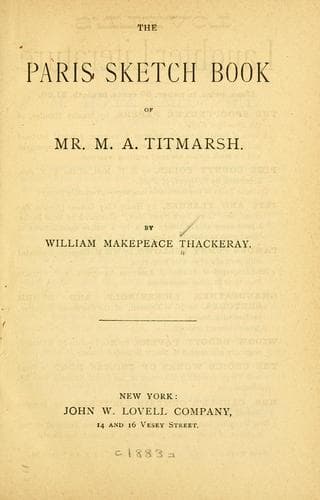
The Paris Sketch Book of Mr. M. A. TitmarshThackeray, William Makepeace
General
The Paris Sketch Book of Mr. M. A. Titmarsh
Thackeray, William Makepeace
Paris (France) -- Description and travel
“Dieu est mort,” says another writer of the same class, and of great
genius too.—“Dieu est mort,” writes Mr. Henry Heine, speaking of the
Christian God; and he adds, in a daring figure of
speech;—“N’entendez-vous pas sonner la Clochette?—on porte les
sacremens à un Dieu qui se meurt!” Another of the pantheist poetical
philosophers, Mr. Edgar Quinet, has a poem, in which Christ and the
Virgin Mary are made to die similarly, and the former is classed with
Prometheus. This book of “Spiridion” is a continuation of the theme,
and perhaps you will listen to some of the author’s expositions of it.
It must be confessed that the controversialists of the present day have
an eminent advantage over their predecessors in the days of folios; it
required some learning then to write a book, and some time, at
least—for the very labor of writing out a thousand such vast pages
would demand a considerable period. But now, in the age of duodecimos,
the system is reformed altogether: a male or female controversialist
draws upon his imagination, and not his learning; makes a story instead
of an argument, and, in the course of 150 pages (where the preacher has
it all his own way) will prove or disprove you anything. And, to our
shame be it said, we Protestants have set the example of this kind of
proselytism—those detestable mixtures of truth, lies, false sentiment,
false reasoning, bad grammar, correct and genuine philanthropy and
piety—I mean our religious tracts, which any woman or man, be he ever
so silly, can take upon himself to write, and sell for a penny, as if
religious instruction were the easiest thing in the world. We, I say,
have set the example in this kind of composition, and all the sects of
the earth will, doubtless, speedily follow it. I can point you out
blasphemies in famous pious tracts that are as dreadful as those above
mentioned; but this is no place for such discussions, and we had better
return to Madame Sand. As Mrs. Sherwood expounds, by means of many
touching histories and anecdotes of little boys and girls, her notions
of church history, church catechism, church doctrine;—as the author of
“Father Clement, a Roman Catholic Story,” demolishes the stately
structure of eighteen centuries, the mighty and beautiful Roman
Catholic faith, in whose bosom repose so many saints and sages,—by the
means of a three-and-sixpenny duodecimo volume, which tumbles over the
vast fabric, as David’s pebble-stone did Goliath;—as, again, the Roman
Catholic author of “Geraldine” falls foul of Luther and Calvin, and
drowns the awful echoes of their tremendous protest by the sounds of
her little half-crown trumpet: in like manner, by means of pretty
sentimental tales, and cheap apologues, Mrs. Sand proclaims HER
truth—that we need a new Messiah, and that the Christian religion is no
more! O awful, awful name of God! Light unbearable! Mystery
unfathomable! Vastness immeasurable!—Who are these who come forward to
Public-domain text, read in full here on John Shaqi.
Reviews
Reviews
No reviews yet
Be the first to share your thoughts on this work.
Elsewhere in the archive
Join the Discussion
Join the discussion
Sign in to leave a comment or review.
Sign InorCreate an account