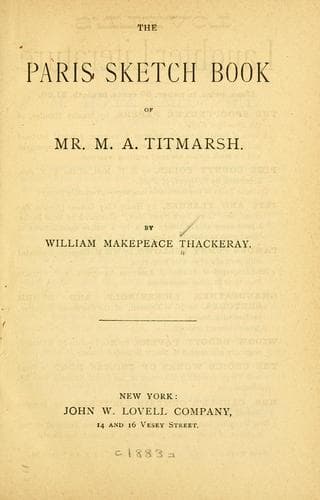
The Paris Sketch Book of Mr. M. A. TitmarshThackeray, William Makepeace
General
The Paris Sketch Book of Mr. M. A. Titmarsh
Thackeray, William Makepeace
Paris (France) -- Description and travel
And tell us who have been the social reformers?—the haters, that is, of
the present system, according to which we live, love, marry, have
children, educate them, and endow them—ARE THEY PURE THEMSELVES? I do
believe not one; and directly a man begins to quarrel with the world
and its ways, and to lift up, as he calls it, the voice of his despair,
and preach passionately to mankind about this tyranny of faith,
customs, laws; if we examine what the personal character of the
preacher is, we begin pretty clearly to understand the value of the
doctrine. Any one can see why Rousseau should be such a whimpering
reformer, and Byron such a free and easy misanthropist, and why our
accomplished Madame Sand, who has a genius and eloquence inferior to
neither, should take the present condition of mankind (French-kind) so
much to heart, and labor so hotly to set it right.
After “Indiana” (which, we presume, contains the lady’s notions upon
wives and husbands) came “Valentine,” which may be said to exhibit her
doctrine, in regard of young men and maidens, to whom the author would
accord, as we fancy, the same tender license. “Valentine” was followed
by “Lelia,” a wonderful book indeed, gorgeous in eloquence, and rich in
magnificent poetry: a regular topsyturvyfication of morality, a
thieves’ and prostitutes’ apotheosis. This book has received some late
enlargements and emendations by the writer; it contains her notions on
morals, which, as we have said, are so peculiar, that, alas! they only
can be mentioned here, not particularized: but of “Spiridion” we may
write a few pages, as it is her religious manifesto.
In this work, the lady asserts her pantheistical doctrine, and openly
attacks the received Christian creed. She declares it to be useless
now, and unfitted to the exigencies and the degree of culture of the
actual world; and, though it would be hardly worth while to combat her
opinions in due form, it is, at least, worth while to notice them, not
merely from the extraordinary eloquence and genius of the woman
herself, but because they express the opinions of a great number of
people besides: for she not only produces her own thoughts, but
imitates those of others very eagerly; and one finds in her writings so
much similarity with others, or, in others, so much resemblance to her,
that the book before us may pass for the expression of the sentiments
of a certain French party.
Public-domain text, read in full here on John Shaqi.
Reviews
Reviews
No reviews yet
Be the first to share your thoughts on this work.
Elsewhere in the archive
Join the Discussion
Join the discussion
Sign in to leave a comment or review.
Sign InorCreate an account