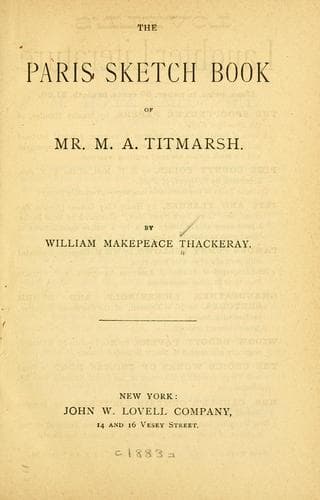
The Paris Sketch Book of Mr. M. A. TitmarshThackeray, William Makepeace
General
The Paris Sketch Book of Mr. M. A. Titmarsh
Thackeray, William Makepeace
Paris (France) -- Description and travel
The individual in tight boots and a rolling collar, with the copious
golden locks, and the solemn blue eyes, who had just gazed on
Spiridion, and inspired him with such a feeling of tender awe, is a
much more important personage than the reader might suppose at first
sight. This beautiful, mysterious, dandy ghost, whose costume, with a
true woman’s coquetry, Madame Dudevant has so rejoiced to describe—is
her religious type, a mystical representation of Faith struggling up
towards Truth, through superstition, doubt, fear, reason,—in tight
inexpressibles, with “a belt such as is worn by the old German
students.” You will pardon me for treating such an awful person as this
somewhat lightly; but there is always, I think, such a dash of the
ridiculous in the French sublime, that the critic should try and do
justice to both, or he may fail in giving a fair account of either.
This character of Hebronius, the type of Mrs. Sand’s convictions—if
convictions they may be called—or, at least, the allegory under which
her doubts are represented, is, in parts, very finely drawn; contains
many passages of truth, very deep and touching, by the side of others
so entirely absurd and unreasonable, that the reader’s feelings are
continually swaying between admiration and something very like
contempt—always in a kind of wonder at the strange mixture before him.
But let us hear Madame Sand:—
“Peter Hebronius,” says our author, “was not originally so named. His
real name was Samuel. He was a Jew, and born in a little village in the
neighborhood of Innsprück. His family, which possessed a considerable
fortune, left him, in his early youth, completely free to his own
pursuits. From infancy he had shown that these were serious. He loved
to be alone and passed his days, and sometimes his nights, wandering
among the mountains and valleys in the neighborhood of his birthplace.
He would often sit by the brink of torrents, listening to the voice of
their waters, and endeavoring to penetrate the meaning which Nature had
hidden in those sounds. As he advanced in years, his inquiries became
more curious and more grave. It was necessary that he should receive a
solid education, and his parents sent him to study in the German
universities. Luther had been dead only a century, and his words and
his memory still lived in the enthusiasm of his disciples. The new
faith was strengthening the conquests it had made; the Reformers were
as ardent as in the first days, but their ardor was more enlightened
and more measured. Proselytism was still carried on with zeal, and new
converts were made every day. In listening to the morality and to the
dogmas which Lutheranism had taken from Catholicism, Samuel was filled
with admiration. His bold and sincere spirit instantly compared the
doctrines which were now submitted to him, with those in the belief of
which he had been bred; and, enlightened by the comparison, was not
slow to acknowledge the inferiority of Judaism. He said to himself,
Public-domain text, read in full here on John Shaqi.
Reviews
Reviews
No reviews yet
Be the first to share your thoughts on this work.
Elsewhere in the archive
Join the Discussion
Join the discussion
Sign in to leave a comment or review.
Sign InorCreate an account