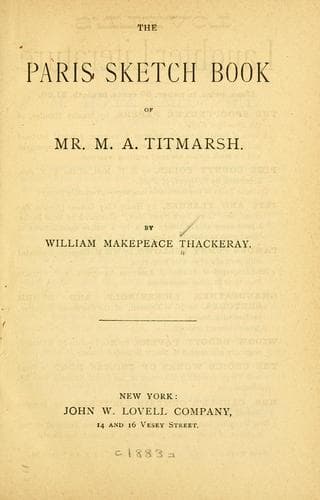
The Paris Sketch Book of Mr. M. A. TitmarshThackeray, William Makepeace
General
The Paris Sketch Book of Mr. M. A. Titmarsh
Thackeray, William Makepeace
Paris (France) -- Description and travel
that a religion made for a single people, to the exclusion of all
others,—which only offered a barbarous justice for rule of
conduct,—which neither rendered the present intelligible nor
satisfactory, and left the future uncertain,—could not be that of noble
souls and lofty intellects; and that he could not be the God of truth
who had dictated, in the midst of thunder, his vacillating will, and
had called to the performance of his narrow wishes the slaves of a
vulgar terror. Always conversant with himself, Samuel, who had spoken
what he thought, now performed what he had spoken; and, a year after
his arrival in Germany, solemnly abjured Judaism, and entered into the
bosom of the Reformed Church. As he did not wish to do things by
halves, and desired as much as was in him to put off the old man and
lead a new life, he changed his name of Samuel to that of Peter. Some
time passed, during which he strengthened and instructed himself in his
new religion. Very soon he arrived at the point of searching for
objections to refute, and adversaries to overthrow. Bold and
enterprising, he went at once to the strongest, and Bossuet was the
first Catholic author that he set himself to read. He commenced with a
kind of disdain; believing that the faith which he had just embraced
contained the pure truth. He despised all the attacks which could be
made against it, and laughed already at the irresistible arguments
which he was to find in the works of the Eagle of Meaux. But his
mistrust and irony soon gave place to wonder first, and then to
admiration: he thought that the cause pleaded by such an advocate must,
at least, be respectable; and, by a natural transition, came to think
that great geniuses would only devote themselves to that which was
great. He then studied Catholicism with the same ardor and impartiality
which he had bestowed on Lutheranism. He went into France to gain
instruction from the professors of the Mother Church, as he had from
the Doctors of the reformed creed in Germany. He saw Arnauld Fénélon,
that second Gregory of Nazianzen, and Bossuet himself. Guided by these
masters, whose virtues made him appreciate their talents the more, he
rapidly penetrated to the depth of the mysteries of the Catholic
doctrine and morality. He found, in this religion, all that had for him
constituted the grandeur and beauty of Protestantism,—the dogmas of the
Unity and Eternity of God, which the two religions had borrowed from
Judaism; and, what seemed the natural consequence of the last
doctrine—a doctrine, however, to which the Jews had not arrived—the
doctrine of the immortality of the soul; free will in this life; in the
next, recompense for the good, and punishment for the evil. He found,
more pure, perhaps, and more elevated in Catholicism than in
Protestantism, that sublime morality which preaches equality to man,
fraternity, love, charity, renouncement of self, devotion to your
neighbor; Catholicism, in a word, seemed to possess that vast formula,
Public-domain text, read in full here on John Shaqi.
Reviews
Reviews
No reviews yet
Be the first to share your thoughts on this work.
Elsewhere in the archive
Join the Discussion
Join the discussion
Sign in to leave a comment or review.
Sign InorCreate an account