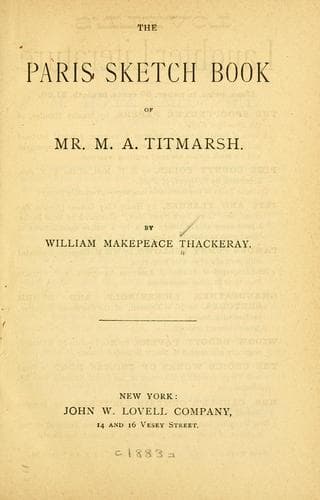
The Paris Sketch Book of Mr. M. A. TitmarshThackeray, William Makepeace
General
The Paris Sketch Book of Mr. M. A. Titmarsh
Thackeray, William Makepeace
Paris (France) -- Description and travel
Then, fatigued with his vain toils
and hopeless endeavors, he would sink down depressed, unmanned,
life-wearied, only living in the sensation of that silent grief which
he felt and could not comprehend.”
It is a pity that this hapless Spiridion, so eager in his passage from
one creed to another, and so loud in his profession of the truth,
wherever he fancied that he had found it, had not waited a little,
before he avowed himself either Catholic or Protestant, and implicated
others in errors and follies which might, at least, have been confined
to his own bosom, and there have lain comparatively harmless. In what a
pretty state, for instance, will Messrs. Dr—d and P—l have left their
Newman Street congregation, who are still plunged in their old
superstitions, from which their spiritual pastors and masters have been
set free! In what a state, too, do Mrs. Sand and her brother and sister
philosophers, Templars, Saint Simonians, Fourierites, Lerouxites, or
whatever the sect may be, leave the unfortunate people who have
listened to their doctrines, and who have not the opportunity, or the
fiery versatility of belief, which carries their teachers from one
creed to another, leaving only exploded lies and useless recantations
behind them! I wish the state would make a law that one individual
should not be allowed to preach more than one doctrine in his life, or,
at any rate, should be soundly corrected for every change of creed. How
many charlatans would have been silenced,—how much conceit would have
been kept within bounds,—how many fools, who are dazzled by fine
sentences, and made drunk by declamation, would have remained, quiet
and sober, in that quiet and sober way of faith which their fathers
held before them. However, the reader will be glad to learn that, after
all his doubts and sorrows, Spiridion does discover the truth (THE
truth, what a wise Spiridion!) and some discretion with it; for, having
found among his monks, who are dissolute, superstitious—and all hate
him—one only being, Fulgentius, who is loving, candid, and pious, he
says to him, “If you were like myself, if the first want of your nature
were, like mine, to know, I would, without hesitation, lay bare to you
my entire thoughts. I would make you drink the cup of truth, which I
myself have filled with so many tears, at the risk of intoxicating you
with the draught. But it is not so, alas! you are made to love rather
than to know, and your heart is stronger than your intellect. You are
attached to Catholicism,—I believe so, at least,—by bonds of sentiment
which you could not break without pain, and which, if you were to
break, the truth which I could lay bare to you in return would not
repay you for what you had sacrificed. Instead of exalting, it would
crush you, very likely. It is a food too strong for ordinary men, and
which, when it does not revivify, smothers. I will not, then, reveal to
you this doctrine, which is the triumph of my life, and the consolation
Public-domain text, read in full here on John Shaqi.
Reviews
Reviews
No reviews yet
Be the first to share your thoughts on this work.
Elsewhere in the archive
Join the Discussion
Join the discussion
Sign in to leave a comment or review.
Sign InorCreate an account