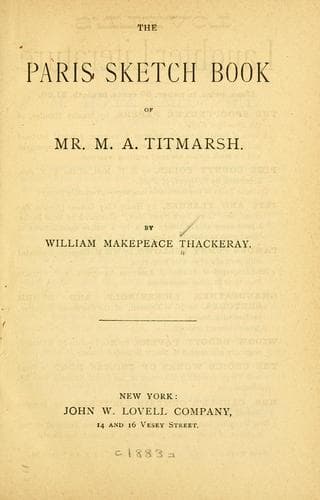
The Paris Sketch Book of Mr. M. A. TitmarshThackeray, William Makepeace
General
The Paris Sketch Book of Mr. M. A. Titmarsh
Thackeray, William Makepeace
Paris (France) -- Description and travel
I think the fate of our English Newman Street apostles, and of M. de la
M—, the mad priest, and his congregation of mad converts, should be a
warning to such of us as are inclined to dabble in religious
speculations; for, in them, as in all others, our flighty brains soon
lose themselves, and we find our reason speedily lying prostrated at
the mercy of our passions; and I think that Madame Sand’s novel of
Spiridion may do a vast deal of good, and bears a good moral with it;
though not such an one, perhaps, as our fair philosopher intended. For
anything he learned, Samuel-Peter-Spiridion-Hebronius might have
remained a Jew from the beginning to the end. Wherefore be in such a
hurry to set up new faiths? Wherefore, Madame Sand, try and be so
preternaturally wise? Wherefore be so eager to jump out of one
religion, for the purpose of jumping into another? See what good this
philosophical friskiness has done you, and on what sort of ground you
are come at last. You are so wonderfully sagacious, that you flounder
in mud at every step; so amazingly clear-sighted, that your eyes cannot
see an inch before you, having put out, with that extinguishing genius
of yours, every one of the lights that are sufficient for the conduct
of common men. And for what? Let our friend Spiridion speak for
himself. After setting up his convent, and filling it with monks, who
entertain an immense respect for his wealth and genius, Father
Hebronius, unanimously elected prior, gives himself up to further
studies, and leaves his monks to themselves. Industrious and sober as
they were, originally, they grow quickly intemperate and idle; and
Hebronius, who does not appear among his flock until he has freed
himself of the Catholic religion, as he has of the Jewish and the
Protestant, sees, with dismay, the evil condition of his disciples, and
regrets, too late, the precipitancy by which he renounced, then and for
ever, Christianity. “But, as he had no new religion to adopt in its
place, and as, grown more prudent and calm, he did not wish to accuse
himself unnecessarily, once more, of inconstancy and apostasy, he still
maintained all the exterior forms of the worship which inwardly he had
abjured. But it was not enough for him to have quitted error, it was
necessary to discover truth. But Hebronius had well looked round to
discover it; he could not find anything that resembled it. Then
commenced for him a series of sufferings, unknown and terrible. Placed
face to face with doubt, this sincere and religious spirit was
frightened at its own solitude; and as it had no other desire nor aim
on earth than truth, and nothing else here below interested it, he
lived absorbed in his own sad contemplations, looked ceaselessly into
the vague that surrounded him like an ocean without bounds, and seeing
the horizon retreat and retreat as ever he wished to near it. Lost in
this immense uncertainty, he felt as if attacked by vertigo, and his
thoughts whirled within his brain.
Public-domain text, read in full here on John Shaqi.
Reviews
Reviews
No reviews yet
Be the first to share your thoughts on this work.
Elsewhere in the archive
Join the Discussion
Join the discussion
Sign in to leave a comment or review.
Sign InorCreate an account