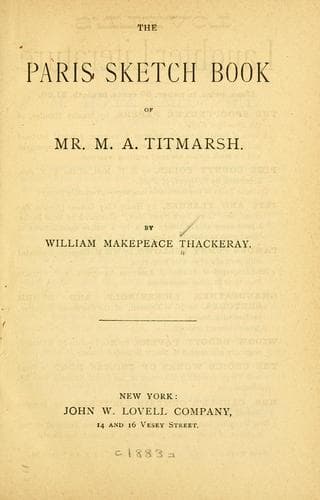
The Paris Sketch Book of Mr. M. A. TitmarshThackeray, William Makepeace
General
The Paris Sketch Book of Mr. M. A. Titmarsh
Thackeray, William Makepeace
Paris (France) -- Description and travel
violent, more threatening. I thought that I was pursued by this
disorderly crowd; and I strove to advance, hurrying into the midst of
those dismal sculptures. Then it seemed as if those figures began to
heave,—and to sweat blood,—and their beady eyes to move in their
sockets. At once I beheld that they were all looking upon me, that they
were all leaning towards me,—some with frightful derision, others with
furious aversion. Every arm was raised against me, and they made as
though they would crush me with the quivering limbs they had torn one
from the other.”....
It is, indeed, a pity that the poor fellow gave himself the trouble to
go down into damp, unwholesome graves, for the purpose of fetching up a
few trumpery sheets of manuscript; and if the public has been rather
tired with their contents, and is disposed to ask why Mrs. Sand’s
religious or irreligious notions are to be brought forward to people
who are quite satisfied with their own, we can only say that this lady
is the representative of a vast class of her countrymen, whom the wits
and philosophers of the eighteenth century have brought to this
condition. The leaves of the Diderot and Rousseau tree have produced
this goodly fruit: here it is, ripe, bursting, and ready to fall;—and
how to fall? Heaven send that it may drop easily, for all can see that
the time is come.
THE CASE OF PEYTEL:
IN A LETTER TO EDWARD BRIEFLESS, ESQUIRE, OF PUMP COURT, TEMPLE.
PARIS, November, 1839.
MY DEAR BRIEFLESS,—Two months since, when the act of accusation first
appeared, containing the sum of the charges against Sebastian Peytel,
all Paris was in a fervor on the subject. The man’s trial speedily
followed, and kept for three days the public interest wound up to a
painful point. He was found guilty of double murder at the beginning of
September; and, since that time, what with Maroto’s disaffection and
Turkish news, we have had leisure to forget Monsieur Peytel, and to
occupy ourselves with [Greek text omitted]. Perhaps Monsieur de Balzac
helped to smother what little sparks of interest might still have
remained for the murderous notary. Balzac put forward a letter in his
favor, so very long, so very dull, so very pompous, promising so much,
and performing so little, that the Parisian public gave up Peytel and
his case altogether; nor was it until to-day that some small feeling
was raised concerning him, when the newspapers brought the account how
Peytel’s head had been cut off at Bourg.
Public-domain text, read in full here on John Shaqi.
Reviews
Reviews
No reviews yet
Be the first to share your thoughts on this work.
Elsewhere in the archive
Join the Discussion
Join the discussion
Sign in to leave a comment or review.
Sign InorCreate an account