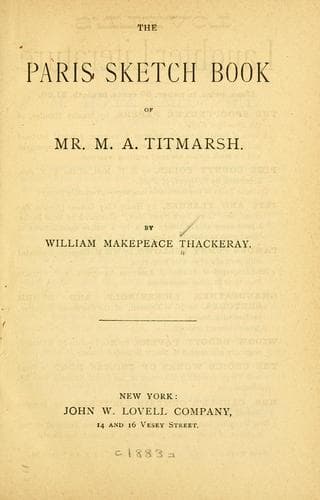
The Paris Sketch Book of Mr. M. A. TitmarshThackeray, William Makepeace
General
The Paris Sketch Book of Mr. M. A. Titmarsh
Thackeray, William Makepeace
Paris (France) -- Description and travel
He had gone through the usual miserable ceremonies and delays which
attend what is called, in this country, the march of justice. He had
made his appeal to the Court of Cassation, which had taken time to
consider the verdict of the Provincial Court, and had confirmed it. He
had made his appeal for mercy; his poor sister coming up all the way
from Bourg (a sad journey, poor thing!) to have an interview with the
King, who had refused to see her. Last Monday morning, at nine o’clock,
an hour before Peytel’s breakfast, the Greffier of Assize Court, in
company with the Curé of Bourg, waited on him, and informed him that he
had only three hours to live. At twelve o’clock, Peytel’s head was off
his body: an executioner from Lyons had come over the night before, to
assist the professional throat-cutter of Bourg.
I am not going to entertain you with any sentimental lamentations for
this scoundrel’s fate, or to declare my belief in his innocence, as
Monsieur de Balzac has done. As far as moral conviction can go, the
man’s guilt is pretty clearly brought home to him. But any man who has
read the “Causes Célèbres,” knows that men have been convicted and
executed upon evidence ten times more powerful than that which was
brought against Peytel. His own account of his horrible case may be
true; there is nothing adduced in the evidence which is strong enough
to overthrow it. It is a serious privilege, God knows, that society
takes upon itself, at any time, to deprive one of God’s creatures of
existence. But when the slightest doubt remains, what a tremendous risk
does it incur! In England, thank heaven, the law is more wise and more
merciful: an English jury would never have taken a man’s blood upon
such testimony: an English judge and Crown advocate would never have
acted as these Frenchmen have done; the latter inflaming the public
mind by exaggerated appeals to their passions: the former seeking, in
every way, to draw confessions from the prisoner, to perplex and
confound him, to do away, by fierce cross-questioning and bitter
remarks from the bench, with any effect that his testimony might have
on the jury. I don’t mean to say that judges and lawyers have been more
violent and inquisitorial against the unhappy Peytel than against any
one else; it is the fashion of the country: a man is guilty until he
proves himself to be innocent; and to batter down his defence, if he
have any, there are the lawyers, with all their horrible ingenuity, and
their captivating passionate eloquence. It is hard thus to set the
skilful and tried champions of the law against men unused to this kind
of combat; nay, give a man all the legal aid that he can purchase or
procure, still, by this plan, you take him at a cruel, unmanly
disadvantage; he has to fight against the law, clogged with the
dreadful weight of his presupposed guilt. Thank God that, in England,
things are not managed so.
Public-domain text, read in full here on John Shaqi.
Reviews
Reviews
No reviews yet
Be the first to share your thoughts on this work.
Elsewhere in the archive
Join the Discussion
Join the discussion
Sign in to leave a comment or review.
Sign InorCreate an account