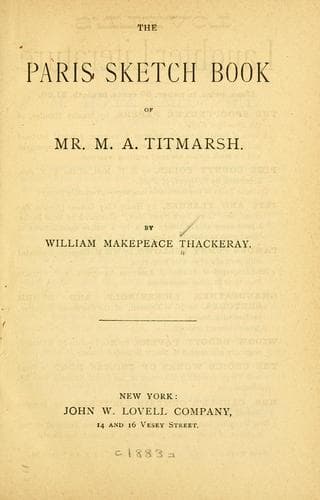
The Paris Sketch Book of Mr. M. A. TitmarshThackeray, William Makepeace
General
The Paris Sketch Book of Mr. M. A. Titmarsh
Thackeray, William Makepeace
Paris (France) -- Description and travel
Now, as there is little reason to tell the reader, when an English
counsel has to prosecute a prisoner on the part of the Crown for a
capital offence, he produces the articles of his accusation in the most
moderate terms, and especially warns the jury to give the accused
person the benefit of every possible doubt that the evidence may give,
or may leave. See how these things are managed in France, and how
differently the French counsel for the Crown sets about his work.
He first prepares his act of accusation, the opening of which we have
just read; it is published six days before the trial, so that an
unimpassioned, unprejudiced jury has ample time to study it, and to
form its opinions accordingly, and to go into court with a happy, just
prepossession against the prisoner.
Read the first part of the Peytel act of accusation; it is as turgid
and declamatory as a bad romance; and as inflated as a newspaper
document, by an unlimited penny-a-liner:—“The department of the Ain is
in a dreadful state of excitement; the inhabitants of Belley come
trooping from their beds,—and what a sight do they behold;—a young
woman at the bottom of a carriage, toute ruisselante, just out of a
river; her garments, in spite of the cold and rain, raised, so as to
leave the upper part of her knees entirely exposed, at which all the
beholders were affected, and cried, that the FIRST DUTY was to cover
her from the cold.” This settles the case at once; the first duty of a
man is to cover the legs of the sufferer; the second to call for help.
The eloquent “Substitut du Procureur du Roi” has prejudged the case, in
the course of a few sentences. He is putting his readers, among whom
his future jury is to be found, into a proper state of mind; he works
on them with pathetic description, just as a romance-writer would: the
rain pours in torrents; it is a dreary evening in November; the young
creature’s situation is neatly described; the distrust which entered
into the breast of the keen old officer of gendarmes strongly painted,
the suspicions which might, or might not, have been entertained by the
inhabitants, eloquently argued. How did the advocate know that the
people had such? did all the bystanders say aloud, “I suspect that this
is a case of murder by Monsieur Peytel, and that his story about the
domestic is all deception?” or did they go off to the mayor, and
register their suspicion? or was the advocate there to hear them? Not
he; but he paints you the whole scene, as though it had existed, and
gives full accounts of suspicions, as if they had been facts, positive,
patent, staring, that everybody could see and swear to.
Having thus primed his audience, and prepared them for the testimony of
the accused party, “Now,” says he, with a fine show of justice, “let us
hear Monsieur Peytel;” and that worthy’s narrative is given as
follows:—
Public-domain text, read in full here on John Shaqi.
Reviews
Reviews
No reviews yet
Be the first to share your thoughts on this work.
Elsewhere in the archive
Join the Discussion
Join the discussion
Sign in to leave a comment or review.
Sign InorCreate an account