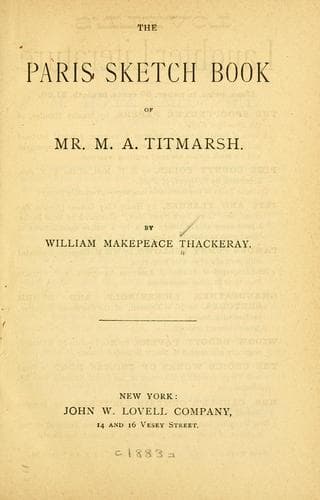
The Paris Sketch Book of Mr. M. A. TitmarshThackeray, William Makepeace
General
The Paris Sketch Book of Mr. M. A. Titmarsh
Thackeray, William Makepeace
Paris (France) -- Description and travel
However, I am not about to entertain you with ignorant disquisitions
about the law. Peytel’s case may, nevertheless, interest you; for the
tale is a very stirring and mysterious one; and you may see how easy a
thing it is for a man’s life to be talked away in France, if ever he
should happen to fall under the suspicion of a crime. The French “Acte
d’accusation” begins in the following manner:—
“Of all the events which, in these latter times, have afflicted the
department of the Ain, there is none which has caused a more profound
and lively sensation than the tragical death of the lady, Félicité
Alcazar, wife of Sebastian Benedict Peytel, notary, at Belley. At the
end of October, 1838, Madame Peytel quitted that town, with her
husband, and their servant Louis Rey, in order to pass a few days at
Macon: at midnight, the inhabitants of Belley were suddenly awakened by
the arrival of Monsieur Peytel, by his cries, and by the signs which he
exhibited of the most lively agitation: he implored the succors of all
the physicians in the town; knocked violently at their doors; rung at
the bells of their houses with a sort of frenzy, and announced that his
wife, stretched out, and dying, in his carriage, had just been shot, on
the Lyons road, by his domestic, whose life Peytel himself had taken.
“At this recital a number of persons assembled, and what a spectacle
was presented to their eyes.
“A young woman lay at the bottom of a carriage, deprived of life; her
whole body was wet, and seemed as if it had just been plunged into the
water. She appeared to be severely wounded in the face; and her
garments, which were raised up, in spite of the cold and rainy weather,
left the upper part of her knees almost entirely exposed. At the sight
of this half-naked and inanimate body, all the spectators were
affected. People said that the first duty to pay to a dying woman was,
to preserve her from the cold, to cover her. A physician examined the
body; he declared that all remedies were useless; that Madame Peytel
was dead and cold.
“The entreaties of Peytel were redoubled; he demanded fresh succors,
and, giving no heed to the fatal assurance which had just been given
him, required that all the physicians in the place should be sent for.
A scene so strange and so melancholy; the incoherent account given by
Peytel of the murder of his wife; his extraordinary movements; and the
avowal which he continued to make, that he had despatched the murderer,
Rey, with strokes of his hammer, excited the attention of Lieutenant
Wolf, commandant of gendarmes: that officer gave orders for the
immediate arrest of Peytel; but the latter threw himself into the arms
of a friend, who interceded for him, and begged the police not
immediately to seize upon his person.
“The corpse of Madame Peytel was transported to her apartment; the
bleeding body of the domestic was likewise brought from the road, where
it lay; and Peytel, asked to explain the circumstance, did so.”....
Public-domain text, read in full here on John Shaqi.
Reviews
Reviews
No reviews yet
Be the first to share your thoughts on this work.
Elsewhere in the archive
Join the Discussion
Join the discussion
Sign in to leave a comment or review.
Sign InorCreate an account