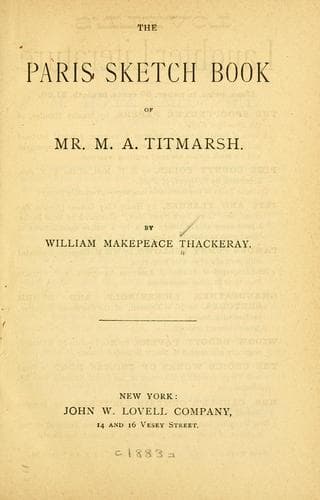
The Paris Sketch Book of Mr. M. A. TitmarshThackeray, William Makepeace
General
The Paris Sketch Book of Mr. M. A. Titmarsh
Thackeray, William Makepeace
Paris (France) -- Description and travel
“And suppose the murderer had succeeded in his criminal projects, what
fruit could he have drawn from them?—Leaving, on the road, the two
bleeding bodies; obliged to lead two carriages at a time, for fear of
discovery; not able to return himself, after all the pains he had taken
to speak, at every place at which they had stopped, of the money which
his master was carrying with him; too prudent to appear alone at
Belley; arrested at the frontier, by the excise officers, who would
present an impassable barrier to him till morning, what could he do, or
hope to do? The examination of the car has shown that Rey, at the
moment of the crime, had neither linen, nor clothes, nor effects of any
kind. There was found in his pockets, when the body was examined, no
passport, nor certificate; one of his pockets contained a ball, of
large calibre, which he had shown, in play, to a girl, at the inn at
Macon, a little horn-handled knife, a snuff-box, a little packet of
gunpowder, and a purse, containing only a halfpenny and some string.
Here is all the baggage, with which, after the execution of his
homicidal plan, Louis Rey intended to take refuge in a foreign
country.[*] Beside these absurd contradictions, there is another
remarkable fact, which must not be passed over; it is this:—the pistol
found by Rey is of antique form, and the original owner of it has been
found. He is a curiosity-merchant at Lyons; and, though he cannot
affirm that Peytel was the person who bought this pistol of him, he
perfectly recognizes Peytel as having been a frequent customer at his
shop!
* This sentence is taken from another part of the “Acte d’accusation.”
“No, we may fearlessly affirm that Louis Rey was not guilty of the
crime which Peytel lays to his charge. If, to those who knew him, his
mild and open disposition, his military career, modest and without a
stain, the touching regrets of his employers, are sufficient proofs of
his innocence,—the calm and candid observer, who considers how the
crime was conceived, was executed, and what consequences would have
resulted from it, will likewise acquit him, and free him of the odious
imputation which Peytel endeavors to cast upon his memory.
“But justice has removed the veil, with which an impious hand
endeavored to cover itself. Already, on the night of the 1st of
November, suspicion was awakened by the extraordinary agitation of
Peytel; by those excessive attentions towards his wife, which came so
late; by that excessive and noisy grief, and by those calculated bursts
of sorrow, which are such as Nature does not exhibit. The criminal,
whom the public conscience had fixed upon; the man whose frightful
combinations have been laid bare, and whose falsehoods, step by step,
have been exposed, during the proceedings previous to the trial; the
murderer, at whose hands a heart-stricken family, and society at large,
demands an account of the blood of a wife;—that murderer is Peytel.”
Public-domain text, read in full here on John Shaqi.
Reviews
Reviews
No reviews yet
Be the first to share your thoughts on this work.
Elsewhere in the archive
Join the Discussion
Join the discussion
Sign in to leave a comment or review.
Sign InorCreate an account