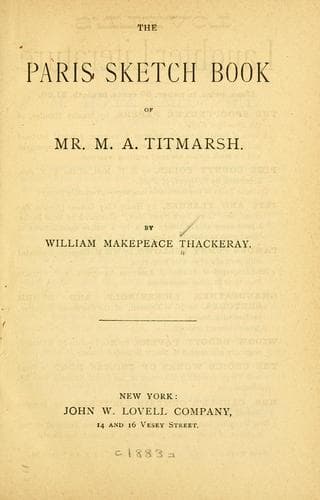
The Paris Sketch Book of Mr. M. A. TitmarshThackeray, William Makepeace
General
The Paris Sketch Book of Mr. M. A. Titmarsh
Thackeray, William Makepeace
Paris (France) -- Description and travel
When, my dear Briefless, you are a judge (as I make no doubt you will
be, when you have left off the club all night, cigar-smoking of
mornings, and reading novels in bed), will you ever find it in your
heart to order a fellow-sinner’s head off upon such evidence as this?
Because a romantic Substitut du Procureur de Roi chooses to compose and
recite a little drama, and draw tears from juries, let us hope that
severe Rhadamanthine judges are not to be melted by such trumpery. One
wants but the description of the characters to render the piece
complete, as thus:—
Personages. Costumes.
SEBASTIAN PEYTAL Meurtrier Habillement complet de notaire
perfide: figure pâle, barbe
noire, cheveux noirs.
LOUIS REY Soldat rétiré, bon, Costume ordinaire; il porte sur
brave, franc, jovial ses épaules une couverture de
aimant le vin, les cheval.
femmes, la gaieté,
ses maîtres surtout;
vrai Français, enfin
WOLF Lieutenant de gendarmerie.
FÉLICITÉ D’ALCAZAR Femme et victime de Peytel.
Médecins, Villageois, Filles d’Auberge, Garçons d’Ecurie, &c. &c.
La scène se passe sur le pont d’Andert, entre Macon et Belley. Il
est minuit. La pluie tombe: les tonnerres grondent. Le ciel est
convert de nuages, et sillonné d’éclairs.
All these personages are brought into play in the Procureur’s drama;
the villagers come in with their chorus; the old lieutenant of
gendarmes with his suspicions; Rey’s frankness and gayety, the romantic
circumstances of his birth, his gallantry and fidelity, are all
introduced, in order to form a contrast with Peytel, and to call down
the jury’s indignation against the latter. But are these proofs? or
anything like proofs? And the suspicions, that are to serve instead of
proofs, what are they?
“My servant, Louis Rey, was very sombre and reserved,” says Peytel; “he
refused to call me in the morning, to carry my money-chest to my room,
to cover the open car when it rained.” The Prosecutor disproves this by
stating that Rey talked with the inn maids and servants, asked if his
master was up, and stood in the inn-yard, grooming the horses, with his
master by his side, neither speaking to the other. Might he not have
talked to the maids, and yet been sombre when speaking to his master?
Might he not have neglected to call his master, and yet have asked
whether he was awake? Might he not have said that the inn-gates were
safe, out of hearing of the ostler witness? Mr. Substitute’s answers to
Peytel’s statements are no answer at all. Every word Peytel said might
be true, and yet Louis Rey might not have committed the murder; or
every word might have been false, and yet Louis Rey might have
committed the murder.
“Then,” says Mr. Substitute, “how many obstacles are there to the
commission of the crime? And these are—
Public-domain text, read in full here on John Shaqi.
Reviews
Reviews
No reviews yet
Be the first to share your thoughts on this work.
Elsewhere in the archive
Join the Discussion
Join the discussion
Sign in to leave a comment or review.
Sign InorCreate an account