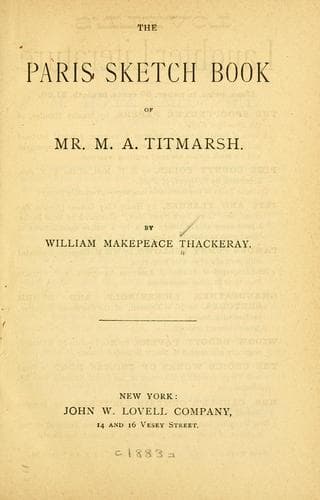
The Paris Sketch Book of Mr. M. A. TitmarshThackeray, William Makepeace
General
The Paris Sketch Book of Mr. M. A. Titmarsh
Thackeray, William Makepeace
Paris (France) -- Description and travel
“1. Rey provided himself with ONE holster pistol, to kill two people,
knowing well that one of them had always a brace of pistols about him.
“2. He does not think of firing until his master’s eyes are open: fires
at six paces, not caring at whom he fires, and then runs away.
“3. He could not have intended to kill his master, because he had no
passport in his pocket, and no clothes; and because he must have been
detained at the frontier until morning; and because he would have had
to drive two carriages, in order to avoid suspicion.
“4. And, a most singular circumstance, the very pistol which was found
by his side had been bought at the shop of a man at Lyons, who
perfectly recognized Peytel as one of his customers, though he could
not say he had sold that particular weapon to Peytel.”
Does it follow, from this, that Louis Rey is not the murderer, much
more, that Peytel is? Look at argument No. 1. Rey had no need to kill
two people: he wanted the money, and not the blood. Suppose he had
killed Peytel, would he not have mastered Madame Peytel easily?—a weak
woman, in an excessively delicate situation, incapable of much energy,
at the best of times.
2. “He does not fire till he knows his master’s eyes are open.” Why, on
a stormy night, does a man driving a carriage go to sleep? Was Rey to
wait until his master snored? “He fires at six paces, not caring whom
he hits;”—and might not this happen too? The night is not so dark but
that he can see his master, in HIS USUAL PLACE, driving. He fires and
hits—whom? Madame Peytel, who had left her place, AND WAS WRAPPED UP
WITH PEYTEL IN HIS CLOAK. She screams out, “Husband, take your
pistols.” Rey knows that his master has a brace, thinks that he has hit
the wrong person, and, as Peytel fires on him, runs away. Peytel
follows, hammer in hand; as he comes up with the fugitive, he deals him
a blow on the back of the head, and Rey falls—his face to the ground.
Is there anything unnatural in this story?—anything so monstrously
unnatural, that is, that it might not be true?
3. These objections are absurd. Why need a man have change of linen? If
he had taken none for the journey, why should he want any for the
escape? Why need he drive two carriages?—He might have driven both into
the river, and Mrs. Peytel in one. Why is he to go to the douane, and
thrust himself into the very jaws of danger? Are there not a thousand
ways for a man to pass a frontier? Do smugglers, when they have to pass
from one country to another, choose exactly those spots where a police
is placed?
Public-domain text, read in full here on John Shaqi.
Reviews
Reviews
No reviews yet
Be the first to share your thoughts on this work.
Elsewhere in the archive
Join the Discussion
Join the discussion
Sign in to leave a comment or review.
Sign InorCreate an account