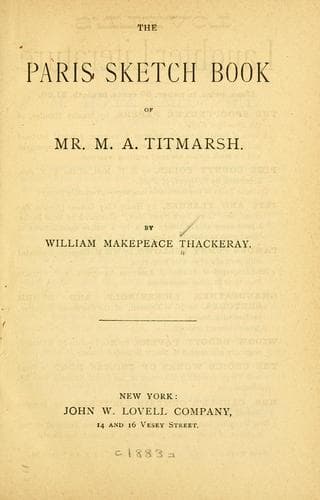
The Paris Sketch Book of Mr. M. A. TitmarshThackeray, William Makepeace
General
The Paris Sketch Book of Mr. M. A. Titmarsh
Thackeray, William Makepeace
Paris (France) -- Description and travel
Near Belley, Peytel first met Félicité Alcazar, who was residing with
her brother-in-law, Monsieur de Montrichard; and, knowing that the
young lady’s fortune was considerable, he made an offer of marriage to
the brother-in-law, who thought the match advantageous, and
communicated on the subject with Félicité’s mother, Madame Alcazar, at
Paris. After a time Peytel went to Paris, to press his suit, and was
accepted. There seems to have been no affectation of love on his side;
and some little repugnance on the part of the lady, who yielded,
however, to the wishes of her parents, and was married. The parties
began to quarrel on the very day of the marriage, and continued their
disputes almost to the close of the unhappy connection. Félicité was
half blind, passionate, sarcastic, clumsy in her person and manners,
and ill educated; Peytel, a man of considerable intellect and
pretensions, who had lived for some time at Paris, where he had mingled
with good literary society. The lady was, in fact, as disagreeable a
person as could well be, and the evidence describes some scenes which
took place between her and her husband, showing how deeply she must
have mortified and enraged him.
A charge very clearly made out against Peytel, is that of dishonesty;
he procured from the notary of whom he bought his place an acquittance
in full, whereas there were 15,000 francs owing, as we have seen. He
also, in the contract of marriage, which was to have resembled, in all
respects, that between Monsieur Broussais and another Demoiselle
Alcazar, caused an alteration to be made in his favor, which gave him
command over his wife’s funded property, without furnishing the
guarantees by which the other son-in-law was bound. And, almost
immediately after his marriage, Peytel sold out of the funds a sum of
50,000 francs, that belonged to his wife, and used it for his own
purposes.
About two months after his marriage, PEYTEL PRESSED HIS WIFE TO MAKE
HER WILL. He had made his, he said, leaving everything to her, in case
of his death: after some parley, the poor thing consented.[*] This is a
cruel suspicion against him; and Mr. Substitute has no need to enlarge
upon it. As for the previous fact, the dishonest statement about the
15,000 francs, there is nothing murderous in that—nothing which a man
very eager to make a good marriage might not do. The same may be said
of the suppression, in Peytel’s marriage contract, of the clause to be
found in Broussais’s, placing restrictions upon the use of the wife’s
money. Mademoiselle d’Alcazar’s friends read the contract before they
signed it, and might have refused it, had they so pleased.
Public-domain text, read in full here on John Shaqi.
Reviews
Reviews
No reviews yet
Be the first to share your thoughts on this work.
Elsewhere in the archive
Join the Discussion
Join the discussion
Sign in to leave a comment or review.
Sign InorCreate an account