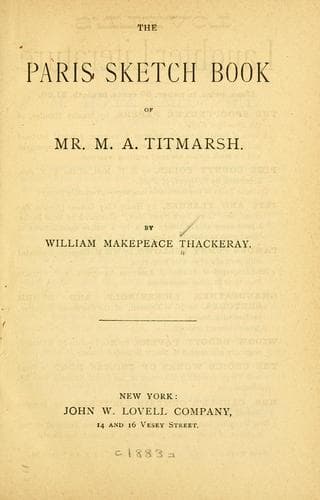
The Paris Sketch Book of Mr. M. A. TitmarshThackeray, William Makepeace
General
The Paris Sketch Book of Mr. M. A. Titmarsh
Thackeray, William Makepeace
Paris (France) -- Description and travel
* “Peytel,” says the act of accusation, “did not fail to see the danger
which would menace him, if this will (which had escaped the magistrates
in their search of Peytel’s papers) was discovered. He, therefore,
instructed his agent to take possession of it, which he did, and the
fact was not mentioned for several months afterwards. Peytel and his
agent were called upon to explain the circumstance, but refused, and
their silence for a long time interrupted the ‘instruction’” (getting
up of the evidence). “All that could be obtained from them was an
avowal, that such a will existed, constituting Peytel his wife’s sole
legatee; and a promise, on their parts, to produce it before the court
gave its sentence.” But why keep the will secret? The anxiety about it
was surely absurd and unnecessary: the whole of Madame Peytel’s family
knew that such a will was made. She had consulted her sister concerning
it, who said—“If there is no other way of satisfying him, make the
will;” and the mother, when she heard of it, cried out—“Does he intend
to poison her?”
After some disputes, which took place between Peytel and his wife
(there were continual quarrels, and continual letters passing between
them from room to room), the latter was induced to write him a couple
of exaggerated letters, swearing “by the ashes of her father” that she
would be an obedient wife to him, and entreating him to counsel and
direct her. These letters were seen by members of the lady’s family,
who, in the quarrels between the couple, always took the husband’s
part. They were found in Peytel’s cabinet, after he had been arrested
for the murder, and after he had had full access to all his papers, of
which he destroyed or left as many as he pleased. The accusation makes
it a matter of suspicion against Peytel, that he should have left these
letters of his wife’s in a conspicuous situation.
“All these circumstances,” says the accusation, “throw a frightful
light upon Peytel’s plans. The letters and will of Madame Peytel are in
the hands of her husband. Three months pass away, and this poor woman
is brought to her home, in the middle of the night, with two balls in
her head, stretched at the bottom of her carriage, by the side of a
peasant.”
Public-domain text, read in full here on John Shaqi.
Reviews
Reviews
No reviews yet
Be the first to share your thoughts on this work.
Elsewhere in the archive
Join the Discussion
Join the discussion
Sign in to leave a comment or review.
Sign InorCreate an account