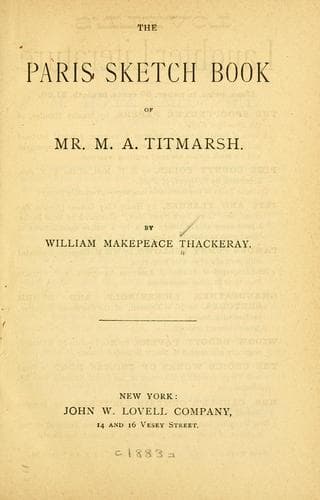
The Paris Sketch Book of Mr. M. A. TitmarshThackeray, William Makepeace
General
The Paris Sketch Book of Mr. M. A. Titmarsh
Thackeray, William Makepeace
Paris (France) -- Description and travel
“This morning, Monday, at nine o’clock, the Greffier of the Assize
Court, in fulfilment of the painful duty which the law imposes upon
him, came to the prison, in company with the curé of Bourg, and
announced to the convict that his petition was rejected, and that he
had only three hours to live. He received this fatal news with a great
deal of calmness, and showed himself to be no more affected than he had
been on the trial. ‘I am ready; but I wish they had given me
four-and-twenty hours’ notice,’—were all the words he used.
“The Greffier now retired, leaving Peytel alone with the curé, who did
not thenceforth quit him. Peytel breakfasted at ten o’clock.
“At eleven, a piquet of mounted gendarmerie and infantry took their
station upon the place before the prison, where a great concourse of
people had already assembled. An open car was at the door. Before he
went out Peytel asked the gaoler for a looking-glass; and having
examined his face for a moment, said, ‘At least, the inhabitants of
Bourg will see that I have not grown thin.’
“As twelve o’clock sounded, the prison gates opened, an aide appeared,
followed by Peytel, leaning on the arm of the curé. Peytel’s face was
pale, he had a long black beard, a blue cap on his head, and his
great-coat flung over his shoulders, and buttoned at the neck.
“He looked about at the place and the crowd; he asked if the carriage
would go at a trot; and on being told that that would be difficult, he
said he would prefer walking, and asked what the road was. He
immediately set out, walking at a firm and rapid pace. He was not bound
at all.
“An immense crowd of people encumbered the two streets through which he
had to pass to the place of execution. He cast his eyes alternately
upon them and upon the guillotine, which was before him.
“Arrived at the foot of the scaffold, Peytel embraced the curé, and
bade him adieu. He then embraced him again; perhaps, for his mother and
sister. He then mounted the steps rapidly, and gave himself into the
hands of the executioner, who removed his coat and cap. He asked how he
was to place himself, and on a sign being made, he flung himself
briskly on the plank, and stretched his neck. In another moment he was
no more.
“The crowd, which had been quite silent, retired, profoundly moved by
the sight it had witnessed. As at all executions, there was a very
great number of women present.
“Under the scaffold there had been, ever since the morning, a coffin.
The family had asked for his remains, and had them immediately buried,
privately: and thus the unfortunate man’s head escaped the modellers in
wax, several of whom had arrived to take an impression of it.”
Public-domain text, read in full here on John Shaqi.
Reviews
Reviews
No reviews yet
Be the first to share your thoughts on this work.
Elsewhere in the archive
Join the Discussion
Join the discussion
Sign in to leave a comment or review.
Sign InorCreate an account