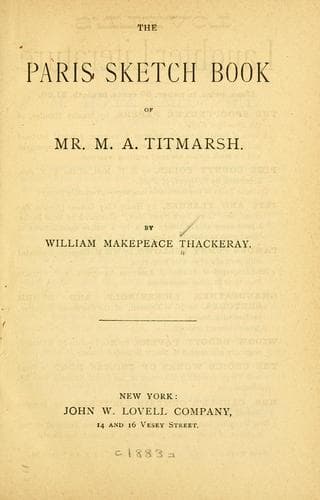
The Paris Sketch Book of Mr. M. A. TitmarshThackeray, William Makepeace
General
The Paris Sketch Book of Mr. M. A. Titmarsh
Thackeray, William Makepeace
Paris (France) -- Description and travel
In like manner, Peytel may not have committed the crime charged to him;
and Mr. Judge, with his arguments as to possibilities and
impossibilities,—Mr. Public Prosecutor, with his romantic narrative and
inflammatory harangues to the jury,—may have used all these powers to
bring to death an innocent man. From the animus with which the case had
been conducted from beginning to end, it was easy to see the result.
Here it is, in the words of the provincial paper:—
BOURG, 28 October, 1839.
“The condemned Peytel has just undergone his punishment, which took
place four days before the anniversary of his crime. The terrible drama
of the bridge of Andert, which cost the life of two persons, has just
terminated on the scaffold. Mid-day had just sounded on the clock of
the Palais: the same clock tolled midnight when, on the 30th of August,
his sentence was pronounced.
“Since the rejection of his appeal in Cassation, on which his principal
hopes were founded, Peytel spoke little of his petition to the King.
The notion of transportation was that which he seemed to cherish most.
However, he made several inquiries from the gaoler of the prison, when
he saw him at meal-time, with regard to the place of execution, the
usual hour, and other details on the subject. From that period, the
words ‘Champ de Foire’ (the fair-field, where the execution was to be
held), were frequently used by him in conversation.
“Yesterday, the idea that the time had arrived seemed to be more
strongly than ever impressed upon him; especially after the departure
of the curé, who latterly has been with him every day. The documents
connected with the trial had arrived in the morning. He was ignorant of
this circumstance, but sought to discover from his guardians what they
tried to hide from him; and to find out whether his petition was
rejected, and when he was to die.
“Yesterday, also, he had written to demand the presence of his counsel,
M. Margerand, in order that he might have some conversation with him,
and regulate his affairs, before he ——; he did not write down the word,
but left in its place a few points of the pen.
“In the evening, whilst he was at supper, he begged earnestly to be
allowed a little wax-candle, to finish what he was writing: otherwise,
he said, TIME MIGHT FAIL. This was a new, indirect manner of repeating
his ordinary question. As light, up to that evening, had been refused
him, it was thought best to deny him in this, as in former instances;
otherwise his suspicions might have been confirmed. The keeper refused
his demand.
Public-domain text, read in full here on John Shaqi.
Reviews
Reviews
No reviews yet
Be the first to share your thoughts on this work.
Elsewhere in the archive
Join the Discussion
Join the discussion
Sign in to leave a comment or review.
Sign InorCreate an account