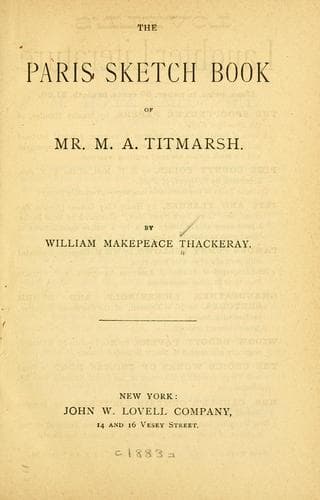
The Paris Sketch Book of Mr. M. A. TitmarshThackeray, William Makepeace
General
The Paris Sketch Book of Mr. M. A. Titmarsh
Thackeray, William Makepeace
Paris (France) -- Description and travel
Then we have Kean, at a place called the Trou de Charbon, the “Coal
Hole,” where, to the edification of the public, he engages in a fisty
combat with a notorious boxer. This scene was received by the audience
with loud exclamations of delight, and commented on, by the journals,
as a faultless picture of English manners. “The Coal Hole” being on the
banks of the Thames, a nobleman—LORD MELBOURN!—has chosen the tavern as
a rendezvous for a gang of pirates, who are to have their ship in
waiting, in order to carry off a young lady with whom his lordship is
enamored. It need not be said that Kean arrives at the nick of time,
saves the innocent Meess Anna, and exposes the infamy of the Peer. A
violent tirade against noblemen ensues, and Lord Melbourn slinks away,
disappointed, to meditate revenge. Kean’s triumphs continue through all
the acts: the Ambassadress falls madly in love with him; the Prince
becomes furious at his ill success, and the Ambassador dreadfully
jealous. They pursue Kean to his dressing-room at the theatre; where,
unluckily, the Ambassadress herself has taken refuge. Dreadful quarrels
ensue; the tragedian grows suddenly mad upon the stage, and so cruelly
insults the Prince of Wales that his Royal Highness determines to send
HIM TO BOTANY BAY. His sentence, however, is commuted to banishment to
New York; whither, of course, Miss Anna accompanies him; rewarding him,
previously, with her hand and twenty thousand a year!
This wonderful performance was gravely received and admired by the
people of Paris: the piece was considered to be decidedly moral,
because the popular candidate was made to triumph throughout, and to
triumph in the most virtuous manner; for, according to the French code
of morals, success among women is, at once, the proof and the reward of
virtue.
The sacred personage introduced in Dumas’s play behind a cloud, figures
bodily in the piece of the Massacre of the Innocents, represented at
Paris last year. She appears under a different name, but the costume is
exactly that of Carlo Dolce’s Madonna; and an ingenious fable is
arranged, the interest of which hangs upon the grand Massacre of the
Innocents, perpetrated in the fifth act. One of the chief characters is
Jean le Précurseur, who threatens woe to Herod and his race, and is
beheaded by orders of that sovereign.
Public-domain text, read in full here on John Shaqi.
Reviews
Reviews
No reviews yet
Be the first to share your thoughts on this work.
Elsewhere in the archive
Join the Discussion
Join the discussion
Sign in to leave a comment or review.
Sign InorCreate an account