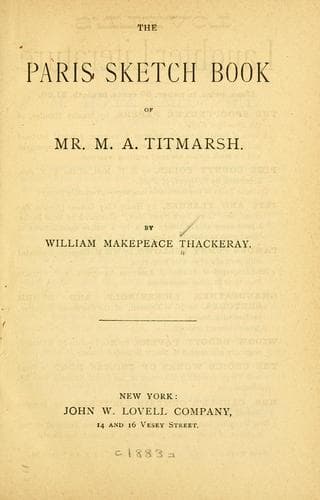
The Paris Sketch Book of Mr. M. A. TitmarshThackeray, William Makepeace
General
The Paris Sketch Book of Mr. M. A. Titmarsh
Thackeray, William Makepeace
Paris (France) -- Description and travel
In the Festin de Balthazar, we are similarly introduced to Daniel, and
the first scene is laid by the waters of Babylon, where a certain
number of captive Jews are seated in melancholy postures; a Babylonian
officer enters, exclaiming, “Chantez nous quelques chansons de
Jerusalem,” and the request is refused in the language of the Psalm.
Belshazzar’s Feast is given in a grand tableau, after Martin’s picture.
That painter, in like manner, furnished scenes for the Deluge. Vast
numbers of schoolboys and children are brought to see these pieces; the
lower classes delight in them. The famous Juif Errant, at the theatre
of the Porte St. Martin, was the first of the kind, and its prodigious
success, no doubt, occasioned the number of imitations which the other
theatres have produced.
The taste of such exhibitions, of course, every English person will
question; but we must remember the manners of the people among whom
they are popular; and, if I may be allowed to hazard such an opinion,
there is in every one of these Boulevard mysteries, a kind of rude
moral. The Boulevard writers don’t pretend to “tabernacles” and divine
gifts, like Madame Sand and Dumas before mentioned. If they take a
story from the sacred books, they garble it without mercy, and take sad
liberties with the text; but they do not deal in descriptions of the
agreeably wicked, or ask pity and admiration for tender-hearted
criminals and philanthropic murderers, as their betters do. Vice is
vice on the Boulevard; and it is fine to hear the audience, as a tyrant
king roars out cruel sentences of death, or a bereaved mother pleads
for the life of her child, making their remarks on the circumstances of
the scene. “Ah, le gredin!” growls an indignant countryman. “Quel
monstre!” says a grisette, in a fury. You see very fat old men crying
like babies, and, like babies, sucking enormous sticks of barley-sugar.
Actors and audience enter warmly into the illusion of the piece; and so
especially are the former affected, that at Franconi’s, where the
battles of the Empire are represented, there is as regular gradation in
the ranks of the mimic army as in the real imperial legions. After a
man has served, with credit, for a certain number of years in the line,
he is promoted to be an officer—an acting officer. If he conducts
himself well, he may rise to be a Colonel or a General of Division; if
ill, he is degraded to the ranks again; or, worst degradation of all,
drafted into a regiment of Cossacks or Austrians. Cossacks is the
lowest depth, however; nay, it is said that the men who perform these
Cossack parts receive higher wages than the mimic grenadiers and old
guard. They will not consent to be beaten every night, even in play; to
be pursued in hundreds, by a handful of French; to fight against their
beloved Emperor. Surely there is fine hearty virtue in this, and
pleasant child-like simplicity.
Public-domain text, read in full here on John Shaqi.
Reviews
Reviews
No reviews yet
Be the first to share your thoughts on this work.
Elsewhere in the archive
Join the Discussion
Join the discussion
Sign in to leave a comment or review.
Sign InorCreate an account