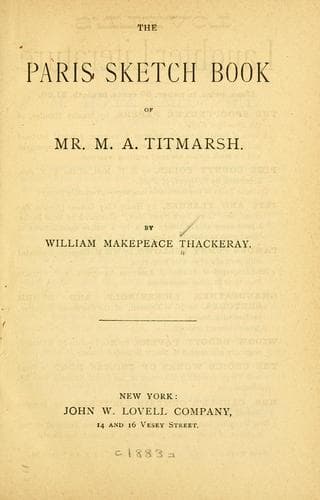
The Paris Sketch Book of Mr. M. A. TitmarshThackeray, William Makepeace
General
The Paris Sketch Book of Mr. M. A. Titmarsh
Thackeray, William Makepeace
Paris (France) -- Description and travel
Morisseau, in the first instance, produces a deed (signed by his
Holiness the Pope), which annuls the marriage of the Duke de la
Vauballière; then another deed, by which it is proved that he was not
the eldest son of old La Vauballière, the former Duke; then another
deed, by which he shows that old La Vauballière (who seems to have been
a disreputable old fellow) was a bigamist, and that, in consequence,
the present man, styling himself Duke, is illegitimate; and finally,
Morisseau brings forward another document, which proves that the
REG’LAR Duke is no other than Adrian, the doctor!
Thus it is that love, law, and physic combined, triumph over the horrid
machinations of this star-and-gartered libertine.
“Hermann l’Ivrogne” is another piece of the same order; and though not
very refined, yet possesses considerable merit. As in the case of the
celebrated Captain Smith of Halifax, who “took to drinking ratafia, and
thought of poor Miss Bailey,”—a woman and the bottle have been the
cause of Hermann’s ruin. Deserted by his mistress, who has been seduced
from him by a base Italian Count, Hermann, a German artist, gives
himself entirely up to liquor and revenge: but when he finds that
force, and not infidelity, have been the cause of his mistress’s ruin,
the reader can fancy the indignant ferocity with which he pursues the
infame ravisseur. A scene, which is really full of spirit, and
excellently well acted, here ensues! Hermann proposes to the Count, on
the eve of their duel, that the survivor should bind himself to espouse
the unhappy Marie; but the Count declares himself to be already
married, and the student, finding a duel impossible (for his object was
to restore, at all events, the honor of Marie), now only thinks of his
revenge, and murders the Count. Presently, two parties of men enter
Hermann’s apartment: one is a company of students, who bring him the
news that he has obtained the prize of painting; the other the
policemen, who carry him to prison, to suffer the penalty of murder.
I could mention many more plays in which the popular morality is
similiarly expressed. The seducer, or rascal of the piece, is always an
aristocrat,—a wicked count, or licentious marquis, who is brought to
condign punishment just before the fall of the curtain. And too good
reason have the French people had to lay such crimes to the charge of
the aristocracy, who are expiating now, on the stage, the wrongs which
they did a hundred years since. The aristocracy is dead now; but the
theatre lives upon traditions: and don’t let us be too scornful at such
simple legends as are handed down by the people from race to race.
Vulgar prejudice against the great it may be; but prejudice against the
great is only a rude expression of sympathy with the poor; long,
therefore, may fat épiciers blubber over mimic woes, and honest
prolétaires shake their fists, shouting—“Gredin, scélérat, monstre de
marquis!” and such republican cries.
Public-domain text, read in full here on John Shaqi.
Reviews
Reviews
No reviews yet
Be the first to share your thoughts on this work.
Elsewhere in the archive
Join the Discussion
Join the discussion
Sign in to leave a comment or review.
Sign InorCreate an account