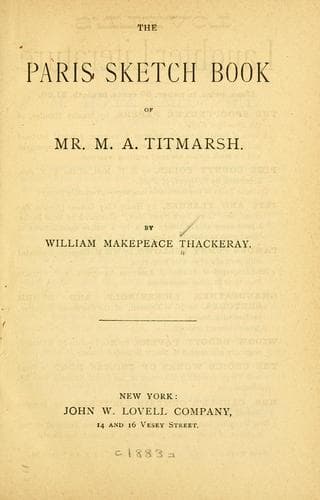
The Paris Sketch Book of Mr. M. A. TitmarshThackeray, William Makepeace
General
The Paris Sketch Book of Mr. M. A. Titmarsh
Thackeray, William Makepeace
Paris (France) -- Description and travel
Remark, too, another development of this same popular feeling of
dislike against men in power. What a number of plays and legends have
we (the writer has submitted to the public, in the preeeding pages, a
couple of specimens; one of French, and the other of Polish origin,) in
which that great and powerful aristocrat, the Devil, is made to be
miserably tricked, humiliated, and disappointed? A play of this class,
which, in the midst of all its absurdities and claptraps, had much of
good in it, was called “Le Maudit des Mers.” Le Maudit is a Dutch
captain, who, in the midst of a storm, while his crew were on their
knees at prayers, blasphemed and drank punch; but what was his
astonishment at beholding an archangel with a sword all covered with
flaming resin, who told him that as he, in this hour of danger, was too
daring, or too wicked, to utter a prayer, he never should cease roaming
the seas until he could find some being who would pray to heaven for
him!
Once only, in a hundred years, was the skipper allowed to land for this
purpose; and this piece runs through four centuries, in as many acts,
describing the agonies and unavailing attempts of the miserable
Dutchman. Willing to go any lengths in order to obtain his prayer, he,
in the second act, betrays a Virgin of the Sun to a follower of
Pizarro: and, in the third, assassinates the heroic William of Nassau;
but ever before the dropping of the curtain, the angel and sword make
their appearance—“Treachery,” says the spirit, “cannot lessen thy
punishment;—crime will not obtain thy release—A la mer! à la mer!” and
the poor devil returns to the ocean, to be lonely, and tempest-tossed,
and sea-sick for a hundred years more.
But his woes are destined to end with the fourth act. Having landed in
America, where the peasants on the sea-shore, all dressed in Italian
costumes, are celebrating, in a quadrille, the victories of Washington,
he is there lucky enough to find a young girl to pray for him. Then the
curse is removed, the punishment is over, and a celestial vessel, with
angels on the decks and “sweet little cherubs” fluttering about the
shrouds and the poop, appear to receive him.
This piece was acted at Franconi’s, where, for once, an angel-ship was
introduced in place of the usual horsemanship.
One must not forget to mention here, how the English nation is
satirized by our neighbors; who have some droll traditions regarding
us. In one of the little Christmas pieces produced at the Palais Royal
(satires upon the follies of the past twelve months, on which all the
small theatres exhaust their wit), the celebrated flight of Messrs.
Green and Monck Mason was parodied, and created a good deal of laughter
at the expense of John Bull. Two English noblemen, Milor Cricri and
Milor Hanneton, appear as descending from a balloon, and one of them
communicates to the public the philosophic observations which were made
in the course of his aërial tour.
Public-domain text, read in full here on John Shaqi.
Reviews
Reviews
No reviews yet
Be the first to share your thoughts on this work.
Elsewhere in the archive
Join the Discussion
Join the discussion
Sign in to leave a comment or review.
Sign InorCreate an account