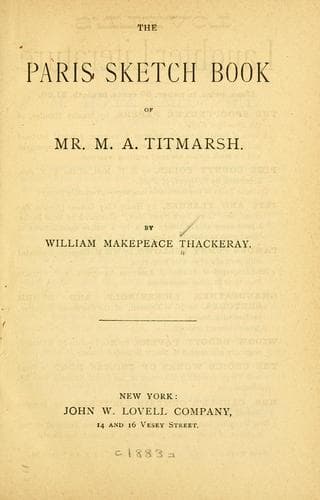
The Paris Sketch Book of Mr. M. A. TitmarshThackeray, William Makepeace
General
The Paris Sketch Book of Mr. M. A. Titmarsh
Thackeray, William Makepeace
Paris (France) -- Description and travel
Contre tous les bas-bleus, contre les pâtissières,
Les parieurs d’Epsom, le gin, le parlement,
La quaterly, le roi, la pluie et les libraires,
Dont il ne touche plus, hélas! un sou d’argent!
Et chaque gentleman lui dit: L’heureux poète!
“L’heureux poète” indeed! I question if a poet in this wide world is so
happy as M. de Beauvoir, or has made such wonderful discoveries. “The
bath of Asia, with green jalousies,” in which the lady dwells; “the old
hotel, with copper lions, in a lonely square;”—were ever such things
heard of, or imagined, but by a Frenchman? The sailors, the negroes,
the vermin, whom he meets in the street,—how great and happy are all
these discoveries! Liston no longer makes the happy poet frown; and
“gin,” “cokneys,” and the “quaterly” have not the least effect upon
him! And this gentleman has lived many months amongst us; admires
Williams Shakspear, the “grave et vieux prophète,” as he calls him, and
never, for an instant, doubts that his description contains anything
absurd!
I don’t know whether the great Dumas has passed any time in England;
but his plays show a similar intimate knowledge of our habits. Thus in
Kean, the stage-manager is made to come forward and address the pit,
with a speech beginning, “My Lords and Gentlemen;” and a company of
Englishwomen are introduced (at the memorable “Coal hole”), and they
all wear PINAFORES; as if the British female were in the invariable
habit of wearing this outer garment, or slobbering her gown without it.
There was another celebrated piece, enacted some years since, upon the
subject of Queen Caroline, where our late adored sovereign, George, was
made to play a most despicable part; and where Signor Bergami fought a
duel with Lord Londonderry. In the last act of this play, the House of
Lords was represented, and Sir Brougham made an eloquent speech in the
Queen’s favor. Presently the shouts of the mob were heard without; from
shouting they proceeded to pelting; and pasteboard-brickbats and
cabbages came flying among the representatives of our hereditary
legislature. At this unpleasant juncture, SIR HARDINGE, the
Secretary-at-War, rises and calls in the military; the act ends in a
general row, and the ignominious fall of Lord Liverpool, laid low by a
brickbat from the mob!
The description of these scenes is, of course, quite incapable of
conveying any notion of their general effect. You must have the
solemnity of the actors, as they Meess and Milor one another, and the
perfect gravity and good faith with which the audience listen to them.
Our stage Frenchman is the old Marquis, with sword, and pigtail, and
spangled court coat. The Englishman of the French theatre has,
invariably, a red wig, and almost always leather gaiters, and a long
white upper Benjamin: he remains as he was represented in the old
caricatures after the peace, when Vernet designed him.
Public-domain text, read in full here on John Shaqi.
Reviews
Reviews
No reviews yet
Be the first to share your thoughts on this work.
Elsewhere in the archive
Join the Discussion
Join the discussion
Sign in to leave a comment or review.
Sign InorCreate an account