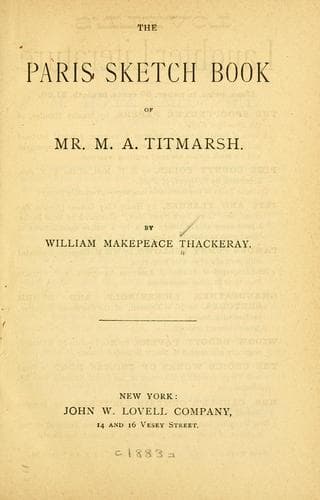
The Paris Sketch Book of Mr. M. A. TitmarshThackeray, William Makepeace
General
The Paris Sketch Book of Mr. M. A. Titmarsh
Thackeray, William Makepeace
Paris (France) -- Description and travel
“On leaving Vauxhall,” says his lordship, “we drank a bottle of
Madeira, as a health to the friends from whom we parted, and crunched a
few biscuits to support nature during the hours before lunch. In two
hours we arrived at Canterbury, enveloped in clouds: lunch, bottled
porter: at Dover, carried several miles in a tide of air, bitter cold,
cherry-brandy; crossed over the Channel safely, and thought with pity
of the poor people who were sickening in the steamboats below: more
bottled porter: over Calais, dinner, roast-beef of Old England; near
Dunkirk,—night falling, lunar rainbow, brandy-and-water; night
confoundedly thick; supper, nightcap of rum-punch, and so to bed. The
sun broke beautifully through the morning mist, as we boiled the kettle
and took our breakfast over Cologne. In a few more hours we concluded
this memorable voyage, and landed safely at Weilburg, in good time for
dinner.”
The joke here is smart enough; but our honest neighbors make many
better, when they are quite unconscious of the fun. Let us leave plays,
for a moment, for poetry, and take an instance of French criticism,
concerning England, from the works of a famous French exquisite and man
of letters. The hero of the poem addresses his mistress—
Londres, tu le sais trop, en fait de capitale,
Est-ce que fit le ciel de plus froid et plus pâle,
C’est la ville du gaz, des marins, du brouillard;
On s’y couche à minuit, et l’on s’y lève tard;
Ses raouts tant vantés ne sont qu’une boxade,
Sur ses grands quais jamais échelle ou sérénade,
Mais de volumineux bourgeois pris de porter
Qui passent sans lever le front à Westminster;
Et n’était sa forêt de mâts perçant la brume,
Sa tour dont à minuit le vieil oeil s’allume,
Et tes deux yeux, Zerline, illuminés bien plus,
Je dirais que, ma foi, des romans que j’ai lus,
Il n’en est pas un seul, plus lourd, plus léthargique
Que cette nation qu’on nomme Britannique!
The writer of the above lines (which let any man who can translate) is
Monsieur Roger de Beauvoir, a gentleman who actually lived many months
in England, as an attaché to the embassy of M. de Polignac. He places
the heroine of his tale in a petit réduit près le Strand, “with a green
and fresh jalousie, and a large blind, let down all day; you fancied
you were entering a bath of Asia, as soon as you had passed the
perfumed threshold of this charming retreat!” He next places her—
Dans un square écarté, morne et couverte de givre,
Où se cache un hôtel, aux vieux lions de cuivre;
and the hero of the tale, a young French poet, who is in London, is
truly unhappy in that village.
Arthur dessèche et meurt. Dans la ville de Sterne,
Rien qu’en voyant le peuple il a le mal de mer
Il n’aime ni le Parc, gai comme une citerne,
Ni le tir au pigeon, ni le soda-water.
Liston ne le fait plus sourciller! Il rumine
Sur les trottoirs du Strand, droit comme un échiquier,
Contre le peuple anglais, les nègres, la vermine,
Et les mille cokneys du peuple boutiquier,
Public-domain text, read in full here on John Shaqi.
Reviews
Reviews
No reviews yet
Be the first to share your thoughts on this work.
Elsewhere in the archive
Join the Discussion
Join the discussion
Sign in to leave a comment or review.
Sign InorCreate an account