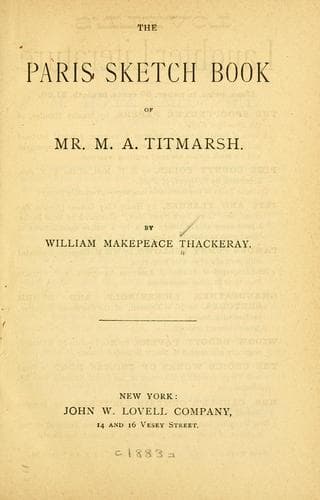
The Paris Sketch Book of Mr. M. A. TitmarshThackeray, William Makepeace
General
The Paris Sketch Book of Mr. M. A. Titmarsh
Thackeray, William Makepeace
Paris (France) -- Description and travel
I have often liked to think about this strange character in the world,
who moved in it, bearing about a full belief in his own infallibility;
teaching his generals the art of war, his ministers the science of
government, his wits taste, his courtiers dress; ordering deserts to
become gardens, turning villages into palaces at a breath; and indeed
the august figure of the man, as he towers upon his throne, cannot fail
to inspire one with respect and awe:—how grand those flowing locks
appear; how awful that sceptre; how magnificent those flowing robes! In
Louis, surely, if in any one, the majesty of kinghood is represented.
But a king is not every inch a king, for all the poet may say; and it
is curious to see how much precise majesty there is in that majestic
figure of Ludovicus Rex. In the Frontispiece, we have endeavored to
make the exact calculation. The idea of kingly dignity is equally
strong in the two outer figures; and you see, at once, that majesty is
made out of the wig, the high-heeled shoes, and cloak, all
fleurs-de-lis bespangled. As for the little lean, shrivelled, paunchy
old man, of five feet two, in a jacket and breeches, there is no
majesty in HIM at any rate; and yet he has just stepped out of that
very suit of clothes. Put the wig and shoes on him, and he is six feet
high;—the other fripperies, and he stands before you majestic,
imperial, and heroic! Thus do barbers and cobblers make the gods that
we worship: for do we not all worship him? Yes; though we all know him
to be stupid, heartless, short, of doubtful personal courage, worship
and admire him we must; and have set up, in our hearts, a grand image
of him, endowed with wit, magnanimity, valor, and enormous heroical
stature.
And what magnanimous acts are attributed to him! or, rather, how
differently do we view the actions of heroes and common men, and find
that the same thing shall be a wonderful virtue in the former, which,
in the latter, is only an ordinary act of duty. Look at yonder window
of the king’s chamber;—one morning a royal cane was seen whirling out
of it, and plumped among the courtiers and guard of honor below. King
Louis had absolutely, and with his own hand, flung his own cane out of
the window, “because,” said he, “I won’t demean myself by striking a
gentleman!” O miracle of magnanimity! Lauzun was not caned, because he
besought majesty to keep his promise,—only imprisoned for ten years in
Pignerol, along with banished Fouquet;—and a pretty story is Fouquet’s
too.
Public-domain text, read in full here on John Shaqi.
Reviews
Reviews
No reviews yet
Be the first to share your thoughts on this work.
Elsewhere in the archive
Join the Discussion
Join the discussion
Sign in to leave a comment or review.
Sign InorCreate an account