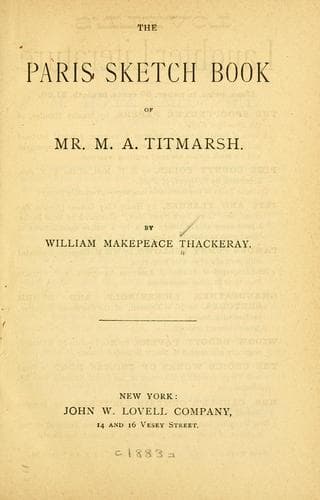
The Paris Sketch Book of Mr. M. A. TitmarshThackeray, William Makepeace
General
The Paris Sketch Book of Mr. M. A. Titmarsh
Thackeray, William Makepeace
Paris (France) -- Description and travel
Out of the window the king’s august head was one day thrust, when old
Condé was painfully toiling up the steps of the court below. “Don’t
hurry yourself, my cousin,” cries magnanimity, “one who has to carry so
many laurels cannot walk fast.” At which all the courtiers, lackeys,
mistresses, chamberlains, Jesuits, and scullions, clasp their hands and
burst into tears. Men are affected by the tale to this very day. For a
century and three-quarters, have not all the books that speak of
Versailles, or Louis Quatorze, told the story?—“Don’t hurry yourself,
my cousin!” O admirable king and Christian! what a pitch of
condescension is here, that the greatest king of all the world should
go for to say anything so kind, and really tell a tottering old
gentleman, worn out with gout, age, and wounds, not to walk too fast!
What a proper fund of slavishness is there in the composition of
mankind, that histories like these should be found to interest and awe
them. Till the world’s end, most likely, this story will have its place
in the history-books; and unborn generations will read it, and tenderly
be moved by it. I am sure that Magnanimity went to bed that night,
pleased and happy, intimately convinced that he had done an action of
sublime virtue, and had easy slumbers and sweet dreams,—especially if
he had taken a light supper, and not too vehemently attacked his en cas
de nuit.
That famous adventure, in which the en cas de nuit was brought into
use, for the sake of one Poquelin alias Molière;—how often has it been
described and admired? This Poquelin, though king’s valet-de-chambre,
was by profession a vagrant; and as such, looked coldly on by the great
lords of the palace, who refused to eat with him. Majesty hearing of
this, ordered his en cas de nuit to be placed on the table, and
positively cut off a wing with his own knife and fork for Poquelin’s
use. O thrice happy Jean Baptiste! The king has actually sat down with
him cheek by jowl, had the liver-wing of a fowl, and given Molière the
gizzard; put his imperial legs under the same mahogany (sub iisdem
trabibus). A man, after such an honor, can look for little else in this
world: he has tasted the utmost conceivable earthly happiness, and has
nothing to do now but to fold his arms, look up to heaven, and sing
“Nunc dimittis” and die.
Public-domain text, read in full here on John Shaqi.
Reviews
Reviews
No reviews yet
Be the first to share your thoughts on this work.
Elsewhere in the archive
Join the Discussion
Join the discussion
Sign in to leave a comment or review.
Sign InorCreate an account