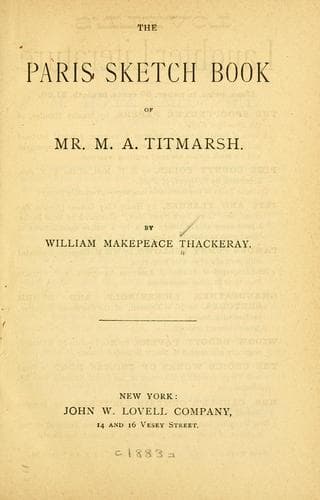
The Paris Sketch Book of Mr. M. A. TitmarshThackeray, William Makepeace
General
The Paris Sketch Book of Mr. M. A. Titmarsh
Thackeray, William Makepeace
Paris (France) -- Description and travel
A year since, as I was smoking my cigar in the “Estaminet du Grand
Balcon,” an excellent smoking-shop, where the tobacco is
unexceptionable, and the Hollands of singular merit, a dark-looking,
thick-set man, in a greasy well-cut coat, with a shabby hat, cocked on
one side of his dirty face, took the place opposite me, at the little
marble table, and called for brandy. I did not much admire the
impudence or the appearance of my friend, nor the fixed stare with
which he chose to examine me. At last, he thrust a great greasy hand
across the table, and said, “Titmarsh, do you forget your old friend
Attwood?”
I confess my recognition of him was not so joyful as on the day ten
years earlier, when he had come, bedizened with lace and gold rings, to
see us at C—— school: a man in the tenth part of a century learns a
deal of worldly wisdom, and his hand, which goes naturally forward to
seize the gloved finger of a millionnaire, or a milor, draws
instinctively back from a dirty fist, encompassed by a ragged wristband
and a tattered cuff. But Attwood was in nowise so backward; and the
iron squeeze with which he shook my passive paw, proved that he was
either very affectionate or very poor. You, my dear sir, who are
reading this history, know very well the great art of shaking hands:
recollect how you shook Lord Dash’s hand the other day, and how you
shook OFF poor Blank, when he came to borrow five pounds of you.
However, the genial influence of the Hollands speedily dissipated
anything like coolness between us and, in the course of an hour’s
conversation, we became almost as intimate as when we were suffering
together under the ferule of old Swishtail. Jack told me that he had
quitted the army in disgust; and that his father, who was to leave him
a fortune, had died ten thousand pounds in debt: he did not touch upon
his own circumstances; but I could read them in his elbows, which were
peeping through his old frock. He talked a great deal, however, of runs
of luck, good and bad; and related to me an infallible plan for
breaking all the play-banks in Europe—a great number of old tricks;—and
a vast quantity of gin-punch was consumed on the occasion; so long, in
fact, did our conversation continue, that, I confess it with shame, the
sentiment, or something stronger, quite got the better of me, and I
have, to this day, no sort of notion how our palaver concluded.—Only,
on the next morning, I did not possess a certain five-pound note which
on the previous evening was in my sketch-book (by far the prettiest
drawing by the way in the collection) but there, instead, was a strip
of paper, thus inscribed:—
IOU Five Pounds. JOHN ATTWOOD, Late of the N—th Dragoons.
I suppose Attwood borrowed the money, from this remarkable and
ceremonious acknowledgment on his part: had I been sober I would just
as soon have lent him the nose on my face; for, in my then
circumstances, the note was of much more consequence to me.
Public-domain text, read in full here on John Shaqi.
Reviews
Reviews
No reviews yet
Be the first to share your thoughts on this work.
Elsewhere in the archive
Join the Discussion
Join the discussion
Sign in to leave a comment or review.
Sign InorCreate an account