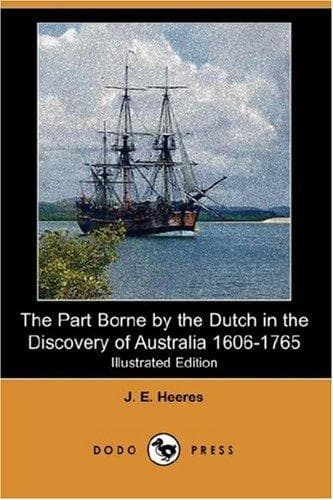
The Part Borne by the Dutch in the Discovery of Australia 1606-1765Heeres, J. E. (Jan Ernst)
History
The Part Borne by the Dutch in the Discovery of Australia 1606-1765
Heeres, J. E. (Jan Ernst)
Australia -- Discovery and exploration; Dutch -- Australia
Waterplaats
Waterplaats bij Van Diemensland, (Noordkust van Australië)
Waterplaats (10° 50')
Waterplaats (12° Z.B. en 160 1/3° O.L.)
Waterplaats (12° 33')
Waterplaats (15° 30')
Waijershoek
Wessel-eiland
Westeinde van Nova Guinea
Westkust van Australië
Willems-rivier
Witte Hoek
W. Sweers'hoek
York, (Schiereiland, Peninsula)
Zuidland, (Het)
Zuidwestkust van Australië
Zuidzee, (De)
Zwanerivier
THE END
17TH CENTURY DUTCH SURNAMES by PETER REYNDERS, (SEPTEMBER 2004.)
Surnames, in the meaning of family names, were relatively uncommon in the
United Provinces (Holland) in the sixteenth and early seventeenth
century. Most people identified themselves using patronymics--a reference
to the first name of their father--as a second name. They were registered
as such at birth. Willem Janszoon would have been the son of Jan (i.e.
Jan's zoon). If Willem J. had a son called Thomas he would have been
registered as Thomas Willemszoon. Because it was unwieldy to spell the
full patronymic, it was common practice to abbreviate written names by
omitting the 'oon' and adding an abbreviation point, Jansz., or by using
the so called internal abbreviation Janszn without such point. The name
was however always pronounced in full and generally still is in the
Netherlands where this bit of common knowledge is taught at school.
Therefore when writing for readers in the English speaking world where
this kind of abbreviation is not recognized as such, we should always
write the name in full, Janszoon, Jacobszoon, Bastiaenszoon, etc., when
referring to people of that period. If we do not, we cause the person to
be known by another name one syllable shorter in the English speaking
world. We inadvertently mislead.
Jansz, Jansen, Janssen, Janzen etc are known as petrified (or frozen)
patronymics and were derived from Janszoon when it became more common
(and under Napoleon legally compulsory) to have a family name. These are
the surnames that still exist today; Janszoon is not in use any more, but
for one family. The shorter unabbreviated name Jansz therefore is
typically NOT a name from the early 17th century.
Historians in Australia, unaware of this bit of linguistic inside
information, have faithfully copied abbreviated names from 17th century
documents and subsequent publications, often without the abbreviation
point and as a result the family names such as Jansz, Jansen, Jantsen,
etc. were widely used to indicate Australia's first recorded European
mariner. There seems to be an effort being made today by those in the
know, including by people of the State Library of NSW, the Duyfken Replica
Foundation, the VOC Historical Society, Australia on the Map 1606-2006,
etc., to call the gentleman in question (Willem) Janszoon with two
syllables including in writing. And it is catching on as it is not hard
to understand how this 'Jansz error' crept into Australian history.
Public-domain text, read in full here on John Shaqi.
Reviews
Reviews
No reviews yet
Be the first to share your thoughts on this work.
Elsewhere in the archive
Join the Discussion
Join the discussion
Sign in to leave a comment or review.
Sign InorCreate an account