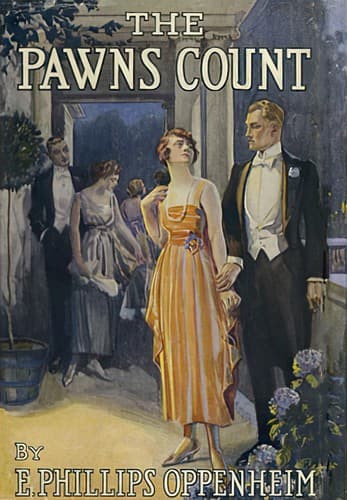
The Pawns CountOppenheim, E. Phillips (Edward Phillips)
General
The Pawns Count
Oppenheim, E. Phillips (Edward Phillips)
Detective and mystery stories
"In the first place, then," her companion began, "your brother belongs
to what I suppose is known as the exclusive set in New York. I am a
Westerner with few friends there. Through him I have obtained
introductions to several people whom it was interesting to me, from a
business point of view, to know."
"I see," Pamela murmured. "You are at least frank, Mr. Fischer."
"I am going to be more frank still," he promised her. "Then another
reason, of course, was because I liked him, and a third, which I am not
sure wasn't the chief of all, because he was your brother."
Pamela laughed gaily.
"Is that necessary?"
"Necessary or not, it's the truth," he assured her. "I am a man of
quick impressions and lasting ones."
"But we've never met except on a steamer," Pamela reminded him.
"I know it's the fashion," Mr. Fischer said, "to turn up one's nose at
steamer acquaintances. It isn't like that with me. You see, I don't
have as much opportunity of meeting folk as some others, perhaps. The
most interesting people I've known socially I've met on steamers. I sat
at your table, side by side with you, Miss Van Teyl, for seven days a
few months ago. I guess I'll remember those seven days as long as I
live."
Pamela turned her head and looked at him. The faintly derisive smile
died away from her lips. The man was in earnest. A certain curiosity
stole into her eyes as the seconds passed. She studied his hard, strong
face, with its great jaw and prominent forehead; the mouth, a little
too full, and belying the rest of his physiognomy, yet with its own
peculiar strength. He had taken off his spectacles, and it seemed to
her that the cold, flinty light of his eyes had caught for a moment
some touch of the softer blue of the sea or the sky. Seated, he lost
some of the awkwardness of his too great and ill-carried height. It
seemed to her that he was at least a person to be reckoned with, either
in friendship or enmity.
"Are you an American born, Mr. Fischer," she asked him.
He shook his head.
"I was born at Offenbach," he told her, "near Frankfurt. My father
brought me out to America when I was eleven years old."
"You must find the present condition of things a little trying for
you," she observed.
Oscar Fischer put on his glasses again. He did not answer for several
moments.
"That opens up a subject, Miss Van Teyl," he said, "which some day I
should like to discuss with you."
"Why not now?" she invited. "I feel much more inclined for conversation
than reading."
"Tell me, then, to begin with," he asked thoughtfully, "on which side
are your sympathies?"
"I try to do my duty as an American citizen," she replied promptly,
"and that is to have no sympathies. Our dear country has set the world
an example of what neutrality should be. I think it is the duty of us
Americans to try and bring ourselves into exactly the same line of
feeling."
He changed his position a little uneasily. His attitude became less of
a sprawl. His eyes were fixed upon her face.
Public-domain text, read in full here on John Shaqi.
Reviews
Reviews
No reviews yet
Be the first to share your thoughts on this work.
Join the Discussion
Join the discussion
Sign in to leave a comment or review.
Sign InorCreate an account