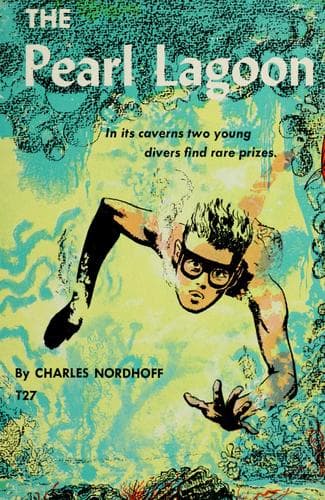
Islands of the Pacific -- Fiction; Oceania -- Fiction; Pearl fisheries -- Fiction; Sea stories
Now Marama's bait was eddying among the other morsels of crab, and I
almost shouted as I saw it disappear in the beak of the larger of the
big blue fish. The native boy struck sharply and began to haul in his
line, cutting the water in crisp zigzags this way and that. A final
heave brought the twenty-pound fish tumbling into the canoe, a blow of
a short club ended its struggles, and I examined it at leisure while
Marama baited his hook once more. It was the first that I had seen--a
strange and beautiful creature, covered with scales larger than a
fifty-cent piece, scales of a vivid iridescent blue with a green spot
at the base of each. A nip of its horny beak would have severed a
man's finger clean. Later that day when I ate my share of it,
steaming-hot from the oven, I understood why the parrot fish was prized
so highly.
When Taura's family assembled for a meal, all of their cooked food came
from the native oven, under the shed behind the house. Their method of
cooking seemed to me--and still seems, when I think of those dinners at
Faatemu--the finest in the world, preserving as it does all the juices
and flavor of fish or fowl or meat. The native cook's equipment
consists of a heap of waterworn pebbles, picked up along the beach, a
pile of large green leaves, and a supply of firewood. Fish and chicken
and pork are cut into pieces of convenient size and made into little
leaf-wrapped packages. Yams, sweet potatoes, plantains, and bananas
are selected for cooking and laid out beside the packages of meat.
Then a shallow hole is scraped out in the earth--perhaps a foot deep,
and two feet across--and a hot fire is built inside. When the fire is
blazing well, the pebbles are heaped on the wood and left till they are
heated almost to a glow. At this stage the hole is raked out clean,
the food put in and covered with hot pebbles, and the whole overlaid
with a thick layer of leaves and earth. An hour later the oven may be
opened, the baked vegetables peeled, and the packages of fish and meat
removed from their clean leafy wrappings.
As time went on, it seemed to me that my friend Marama possessed more
useful accomplishments than any lad of his age at home. The fishing
excursions in which I was always eager to join were in reality his
work, for we supplied more than half of the household's food. My
friend could read and write, but otherwise he had no education in our
sense of the word. He knew nothing of history, algebra, or geometry,
but his mind was a storehouse of complex fishing-lore, picked up
unconsciously since babyhood and enabling him to provide himself and
his family with food. And when you come to think of it, that is one of
the purposes of all education.
Public-domain text, read in full here on John Shaqi.
Reviews
Reviews
No reviews yet
Be the first to share your thoughts on this work.
Join the Discussion
Join the discussion
Sign in to leave a comment or review.
Sign InorCreate an account