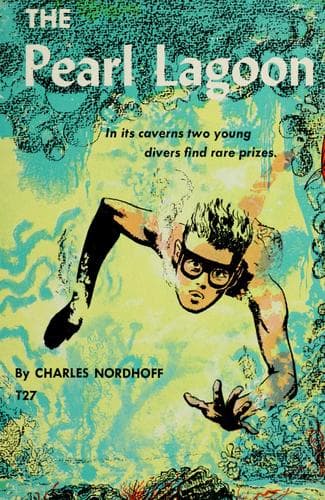
Islands of the Pacific -- Fiction; Oceania -- Fiction; Pearl fisheries -- Fiction; Sea stories
"We must be close to Iriatai," he said to me on the morning of the last
day, "but in these shifting currents, and without a chance for a shot
at the sun, it's hard to say just where we are! Risky business, this
knocking about at night--if we don't raise the land to-day, I'm going
to heave to."
I had been gazing idly at the clouds drifting overhead, and had noticed
several flocks of sea birds, passing high above us, all heading
southward. As my uncle spoke, another flock appeared in the north. He
saw them, too, and shouted a command to alter the schooner's course.
"That's the third lot of birds I've seen this morning," he remarked;
"there's a chance that they are coming from Iriatai. We'll beat up to
the north a bit, and have a look."
An hour later I heard a long-drawn cry from the crosstrees, and soon
from the deck I made out the familiar atoll-landfall--a level dark line
of palm-tops, low on the northern horizon. It was Iriatai.
The island differs from most of the atolls in that the pass is on the
weather side. The lagoon is nearly circular, ten miles long and about
eight across, and the surrounding land is composed of three long
curving islands, separated by short stretches of reef over which the
sea washes no more than knee-deep on a calm day. A dense growth of
young palms--planted by my uncle--covered the islands, and just inside
the pass, where von Tesmar's settlement had stood before the hurricane,
I saw the loftier tops of the trees planted by Turia, the dead Paumotan
woman. From a perch high up in the shrouds, gazing with the glasses
toward the far end of the lagoon, I could make out the tall old palms
of the islet where the woman and her child had fetched up in that
long-ago storm. We were at the end of our voyage: somewhere between
the islet and the reef lay the patch of gold-lipped shell planted by
the strange Austrian wanderer!
That night we anchored the Tara off the village of my uncle's laborers,
natives established on the island to plant and to make copra as the
trees began to bear. Next morning, with a dozen fresh helpers
gossiping on deck and a man at the masthead to give us warning of
shoals, the Tara sailed the length of the lagoon and found a berth
close to the high islet at the farther end. Our divers made their camp
on that ten-acre dot of land, shaded by old palms which had survived
the hurricane.
While the divers floated their canoes ashore and set to work to lash on
the outriggers, the other men launched the boats to transfer the
schooner's cargo to the beach. The women and children went ashore at
once, stacked their belongings in individual heaps, and busied
themselves with plaiting the palm-fronds with which their houses would
be thatched.
Public-domain text, read in full here on John Shaqi.
Reviews
Reviews
No reviews yet
Be the first to share your thoughts on this work.
Join the Discussion
Join the discussion
Sign in to leave a comment or review.
Sign InorCreate an account