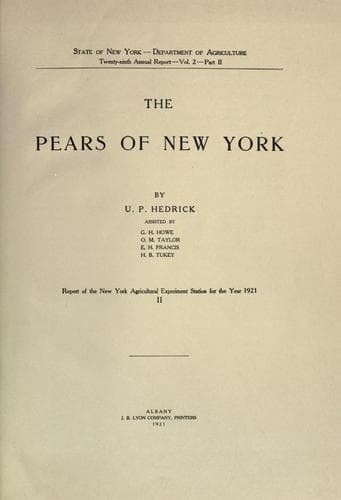
THE PEARS OF NEW YORK
CHAPTER I
HISTORY OF THE PEAR
The pear has no history if history be defined as a record of evolution.
Even the annals of the pear, which but state events in chronological
order, are a heap of confused facts and dates with important data
missing at every turn. The origin of the cultivated pear is so
completely hidden in prehistoric darkness that it can never be known
precisely from what wild pear it came. The historian must content
himself with recording what the pear was when written records began;
what the touch of time has done since the first written accounts; and
what the events and by whom directed which have aided time in making
its impressions since cultivated pears have accompanied its flight.
Happily, it does not matter much what the pear was before husbandmen
appeared on the scene. But from the day the pear began to supply the
needs of men, and in its turn to require ministration from those it
nourished, its history becomes of importance to all mankind. Those whom
it helps sustain as well as those who tend the pear, may well ask:
What was the raw material when the domestication of the pear began?
How has this material been fashioned into the pear of the present? Who
began domestication and who has carried it forward? And, gauged by
past progress, what further progress is possible? These are questions
of prime importance to those who seek to improve the pear; they throw
light on the culture of the pear; and they are of general interest
to all husbandmen, and to all interested in the world's food supply.
The history of the pear is important, as has been said, only as it is
connected with the history of man. Yet, this history must begin with
the wild pear.
WILD PEARS
Botanists number from twenty to twenty-five species of pears, all of
which are found in the northern hemisphere of the Old World, there
being no true pear native to the southern hemisphere or to the New
World. Some ten or twelve wild pears are found in China, several of
which overrun the limits of China; three or four are natives of Japan;
at least one has its habitat in Korea; another is to be found in the
western Himalayas; while the remainder, some eight or ten species,
are found westward from Turkestan, through Persia and Asia Minor into
southern and western Europe and northern Africa. From these statements
as to habitats it is seen that pears grow wild over a very extended
area and under quite varied conditions; therefore, it would be expected
that the several species are quite distinct, differing chiefly,
however, from a horticultural point of view, in the fruits.
Public-domain text, read in full here on John Shaqi.
Reviews
Reviews
No reviews yet
Be the first to share your thoughts on this work.
Join the Discussion
Join the discussion
Sign in to leave a comment or review.
Sign InorCreate an account