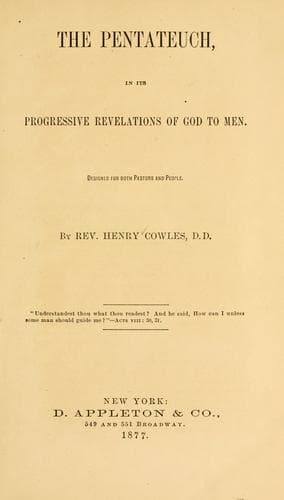
The Pentateuch, in Its Progressive Revelations of God to MenCowles, Henry
Religion
The Pentateuch, in Its Progressive Revelations of God to Men
Cowles, Henry
Bible. Pentateuch -- Criticism, interpretation, etc.
ABRAHAM is one of the great men in the world’s religious history. Why
he is so can not be well understood and appreciated without at least
a brief view of the state of the world religiously considered at the
date of his call, and the demand thence resulting for the new religious
instrumentalities of which Abraham was in a sort “the head-center.”
In the age before the flood religion had never really flourished. We
read of a time when “men began to call on the name of the Lord,” and
something approximating toward system and concentration appears to
have been introduced. But the record is silent as to any marked result
except so far as it may appear in the piety of individual men, _e. g._
Enoch and Noah. Apparently the religious element failed even to hold
its own against the on-rushing tides of worldliness. Even the sons of
godly fathers formed unhallowed marriage connections, and consequently
were borne rapidly down the broad current of degeneracy and moral
corruption till only one family remained to represent the piety of all
that generation. There was a fatal lack of moral forces.――――The flood
was a vigorous moral lesson in itself; and besides this, the race
started afresh from the seed of this one pious family. Ten generations
bring us to Abraham in Ur of the Chaldees, near the old cradle of the
race. The history of religion during this period from Noah to Abraham
is exceedingly meager. Gathering up the few fragmentary notices which
emerge from the general darkness in the age of Abraham, we find that
his father’s family in ancient Ur “served other gods” (Josh. 24: 2);
that Abraham, journeying toward the south country of Palestine,
sojourned awhile in Gerar and was there drawn into grave temptation
by the apparent godlessness of the people, since he apologizes on this
wise for representing Sarah to be his sister and not his wife: “Because
I thought, Surely the fear of God is not in this place; and they will
slay me for my wife’s sake” (Gen. 20: 10, 11). The same temptation
befell him previously in Egypt (Gen. 12: 10–20)――probably indicating
the same inward thought based on the same apparent public morality.
Then we have the horrible wickedness of Sodom and Gomorrah where not
ten righteous men could be found. And sad to say, we see a very low
tone of religious and moral life in the family even of Lot, who as the
nephew and special associate of Abraham should represent the better
elements of society.――――Akin to these special facts is the general one
that the personal history of Abraham through a full century of somewhat
extensive travels and various experience brings him into contact with
God-fearing men in only the single case of Melchizedek. Apart from this
one brief but wonderful interview (Gen. 14: 18–20) the recorded history
of Abraham gives the impression of a godly man working his way for the
most part _alone_, amid godless people on every hand――alone save as the
Lord testifies of him――“I know him that he will command his children
Public-domain text, read in full here on John Shaqi.
Reviews
Reviews
No reviews yet
Be the first to share your thoughts on this work.
Elsewhere in the archive
Join the Discussion
Join the discussion
Sign in to leave a comment or review.
Sign InorCreate an account