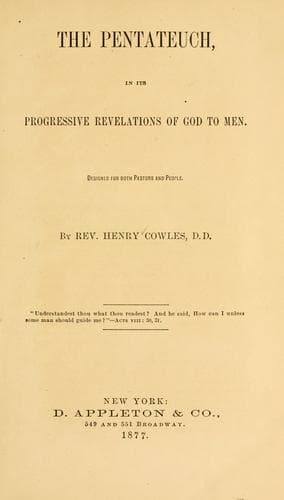
The Pentateuch, in Its Progressive Revelations of God to MenCowles, Henry
Religion
The Pentateuch, in Its Progressive Revelations of God to Men
Cowles, Henry
Bible. Pentateuch -- Criticism, interpretation, etc.
This tower was not built for safety in case of another flood (as some
have supposed) for, with such an object, a high mountain and not a
plain would have been chosen for the site; it could at best have saved
but few; and more than all, the record gives a very different view
of the motive. This motive was _consolidation_――the aggregation of
the masses into one vast nationality or kingdom――a thought due to the
ambition of some controlling minds aspiring to power, distinction,
fame. Foreseeing the tendency to dispersion they sought to forestall it,
to find their own glory in having a multitude under their sway and in
building monuments that could not perish. For wise reasons God blasted
this scheme. Precisely what divine influence was interposed to confound
the language of these men, I doubt if it is possible for us to know
certainly. It is supposable that the many became restive under the
domination of the few and the severe labor of this enterprise, so that
diverse counsels and dissolving social bonds had some influence in
blocking the progress of the work. Misunderstandings sprung up and
found expression in diversities of tongue. What could be more natural
when harmony gave place to discord? So this huge tower-building was
arrested and men scattered abroad as they would.――――The new tongues
which took their rise here had ample opportunity to diverge more and
more widely in subsequent ages. The immense variety in language which
the history of the world discloses has been a growth――the product
of subtle causes, of segregation and non-intercourse in part, and in
part also no doubt of diverse mental traits and various influences of
culture.
What the original language was, common to the race up to this point,
has been much debated by learned men without arriving at uniform and
satisfactory results. Whether it was, as some suppose, the veritable
Hebrew tongue; or as others think, the Aramaic, _i. e._ the Chaldee;
or whether it is utterly lost――these are the alternatives; but for
the choice between them we can have no very positive data. Those
descendants of Noah who best preserved the religious faith of the
fathers would stand most aloof from the scenes of Babel, and be
naturally least affected by its many-tongued controversies and its
resulting confusion of speech. That they escaped these influences
altogether is perhaps too much to assume.――――That the Aramaic (Chaldee)
tongue, closely allied to the Hebrew, held its place for ages in the
valley of the Euphrates, strongly favors its claim to be, if not the
very tongue of Noah, at least of the same family.――――These points
suggest probabilities but fall short of certainty.
CHAPTER X.
ABRAHAM.
Public-domain text, read in full here on John Shaqi.
Reviews
Reviews
No reviews yet
Be the first to share your thoughts on this work.
Elsewhere in the archive
Join the Discussion
Join the discussion
Sign in to leave a comment or review.
Sign InorCreate an account